
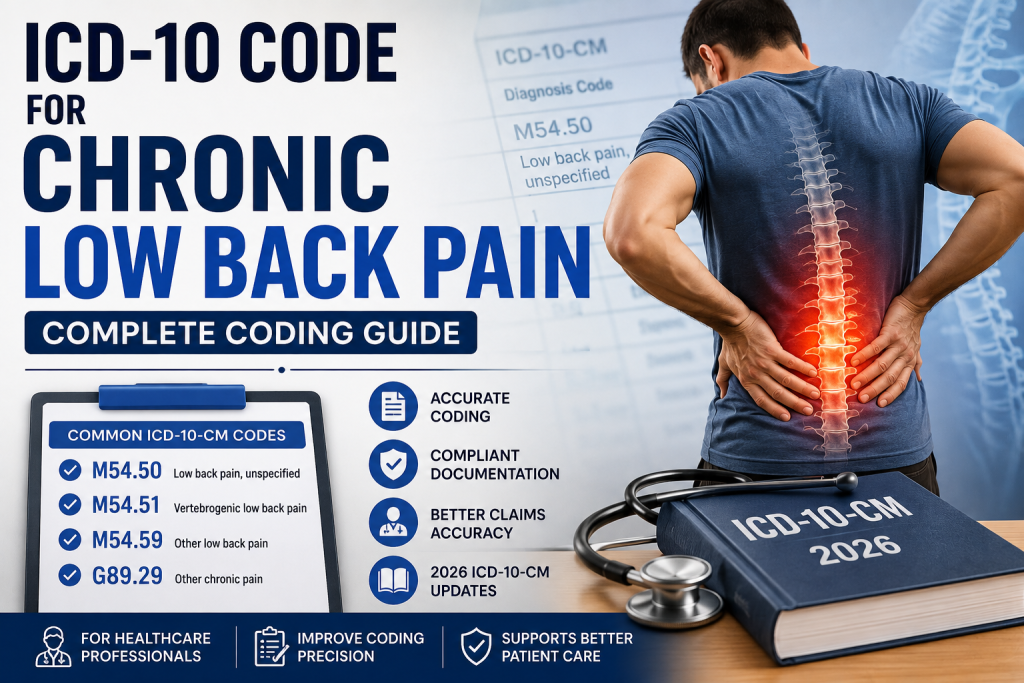
ICD-10 Code for Chronic Low Back Pain: Complete Coding Guide
Understanding medical diagnosis codes is important for healthcare providers, medical billers, coders, and patients who want to better understand their medical records. One commonly searched topic is the ICD-10 Code for Chronic Low Back Pain, particularly when documentation describes persistent pain without identifying one specific underlying condition.
Low back pain can have many causes, including muscle strain, degenerative changes, disc-related conditions, spinal stenosis, nerve irritation, or nonspecific musculoskeletal pain. Because the correct ICD-10-CM code depends on the diagnosis documented by the healthcare provider, there is not always one universal code that applies to every patient.
For fiscal year 2026, ICD-10-CM includes several codes within the M54 category for different types of low back pain. These include M54.50 for unspecified low back pain, M54.51 for vertebrogenic low back pain, and M54.59 for other low back pain.
This guide explains the commonly relevant codes, how chronic pain coding may work, documentation considerations, and why selecting the correct code requires attention to the clinical circumstances ICD-10 Code for Chronic Low Back Pain.
What Is the ICD-10 Code for Chronic Low Back Pain?

The ICD-10 Code for Chronic Low Back Pain is not necessarily a single code that should automatically be used whenever a patient reports long-lasting lower back discomfort.
In ICD-10-CM, the low-back-pain site and the chronic nature of pain can sometimes be represented by different codes. For example, M54.50 describes low back pain that is unspecified, while G89.29 describes other chronic pain. Whether both codes should be reported depends on the documentation and the reason for the encounter.
The official FY 2026 ICD-10-CM guidelines explain that category G89 codes may provide additional information about pain, including whether pain is chronic, but their use depends on the clinical circumstances.
Therefore, coders should not select a chronic-pain code simply because the patient has used the word “chronic.” The complete medical record and provider documentation need to be considered ICD-10 Code for Chronic Low Back Pain.
M54.50: Low Back Pain, Unspecified

M54.50 is one of the commonly encountered ICD-10-CM codes related to low back pain.
Its official description is “Low back pain, unspecified.” It can be relevant when documentation identifies low back pain but does not establish a more specific diagnosis such as vertebrogenic low back pain or another defined condition.
The code does not, by itself, communicate that the pain is chronic. This distinction is important because chronicity and anatomical location are not necessarily represented by the same code.
For example, documentation may describe a patient as having persistent low back pain without establishing a specific structural diagnosis. In that situation, the provider’s documentation must be reviewed before deciding whether M54.50 alone or an additional code is appropriate.
M54.51: Vertebrogenic Low Back Pain

M54.51 is used for vertebrogenic low back pain.
This is different from unspecified low back pain. Vertebrogenic pain refers to a particular type of low back pain associated with the vertebral endplates and related changes. The code was introduced to provide greater specificity for this diagnosis.
A provider should establish the diagnosis before this code is assigned. A coder should not assume that every patient with chronic lower back pain has vertebrogenic pain.
The distinction between M54.50 and M54.51 is therefore clinically important. M54.50 represents unspecified low back pain, whereas M54.51 identifies vertebrogenic low back pain.
M54.59: Other Low Back Pain

Another relevant code is M54.59, which represents other low back pain.
This code may be considered when documentation identifies a type of low back pain that does not fit the unspecified category but does not correspond to vertebrogenic low back pain.
Again, proper code selection depends on the provider’s documentation. Coders should avoid choosing a more specific diagnosis than the medical record supports.
The current FY 2026 ICD-10-CM classification lists M54.50, M54.51, and M54.59 as distinct low-back-pain codes.
Where Does Chronic Pain Code G89.29 Fit?

G89.29 is listed as other chronic pain.
This code belongs to category G89, which covers pain not elsewhere classified. It can provide information about chronic pain in appropriate circumstances.
However, G89.29 should not automatically replace a site-specific diagnosis. The official coding guidelines explain that G89 codes may be used with site-specific pain codes when the additional information is clinically relevant and supported by the circumstances of the encounter.
For this reason, a patient may have a site-specific low-back-pain code and, in appropriate circumstances, an additional chronic-pain code.
The correct combination depends on the documentation, the underlying condition, and why the patient is receiving care.
Why Chronicity Matters in Medical Coding

Chronic pain and acute pain can represent very different clinical situations.
A patient with a recent episode of back pain after lifting a heavy object may have a short-term musculoskeletal problem. Another patient may have persistent pain that has continued for months and requires ongoing management.
The word “chronic” can therefore be clinically meaningful, but coding still requires the provider’s documentation to support the diagnosis and the appropriate classification.
The ICD-10 Code for Chronic Low Back Pain should be selected based on what is actually documented rather than based only on the patient’s general description of symptoms.
This approach helps reduce coding errors and prevents a nonspecific symptom from being incorrectly assigned a more specific diagnosis.
Can M54.50 and G89.29 Be Used Together?

In some circumstances, a low-back-pain code and a chronic-pain code may both be reported. However, this is not an automatic rule for every patient.
The official FY 2026 guidelines state that category G89 codes can be used with site-specific pain codes when the G89 code provides additional information about the pain. Sequencing depends on the circumstances of the encounter.
For example, if the medical record identifies a specific underlying condition that explains the pain, coding may focus on that underlying diagnosis rather than simply reporting a chronic pain code.
If the primary reason for an encounter is pain management, a G89 code may have a different role in sequencing.
Because of these differences, coders should review the complete documentation rather than applying a fixed formula.
Why the Underlying Cause Is Important

Low back pain is a symptom rather than a single disease.
A patient may have low back pain associated with:
- Muscle or ligament strain
- Intervertebral disc disorders
- Spinal stenosis
- Radiculopathy
- Vertebrogenic pain
- Degenerative spinal conditions
- Other musculoskeletal disorders
- Nonspecific low back pain
If the provider has established a definitive underlying diagnosis, that diagnosis may be more appropriate for coding than a generic pain code, depending on the circumstances.
The official ICD-10-CM guidelines specifically explain that G89 codes should not generally be assigned when the underlying definitive diagnosis is known unless the reason for the encounter is pain control or pain management rather than treatment of the underlying condition.
Common ICD-10-CM Codes Related to Low Back Pain

Understanding related codes can make medical records easier to interpret.
M54.50 — Low back pain, unspecified
This code represents low back pain when the documentation does not provide a more specific diagnosis.
M54.51 — Vertebrogenic low back pain
This code identifies a specific form of low back pain associated with vertebrogenic pain.
M54.59 — Other low back pain
This code represents other specified low back pain that does not fit the other available categories.
G89.29 — Other chronic pain
This code belongs to the chronic-pain category and may be appropriate when documentation and encounter circumstances support its use.
These codes should not be treated as interchangeable. The correct selection depends on the diagnosis, documentation, and purpose of the encounter.
How Medical Coders Should Approach Chronic Low Back Pain

When reviewing a record for chronic low back pain, a coder should begin by identifying the provider’s documented diagnosis.
The next step is to determine whether the record specifies a particular cause or type of pain. If the diagnosis is nonspecific low back pain, an unspecified or other low-back-pain code may be relevant.
The coder should then determine whether the pain is documented as chronic and whether a G89 code adds clinically useful information.
Finally, the reason for the encounter should be considered. Treatment of an underlying condition and treatment specifically focused on pain management can affect code sequencing.
This process is more reliable than selecting a code based solely on a search engine result or a patient’s description.
Documentation Needed for Accurate Coding
Good clinical documentation makes accurate coding much easier.
Healthcare providers can improve documentation by clearly recording:
- The location of pain
- The duration of symptoms
- Whether the pain is acute or chronic
- The established diagnosis
- Relevant underlying conditions
- Neurological symptoms when present
- The purpose of the encounter
- The treatment or management provided
- Relevant imaging or examination findings when clinically appropriate
Documentation should reflect the provider’s actual clinical assessment. Coders should not independently diagnose a condition that has not been documented.
The official ICD-10-CM guidelines emphasize that accurate code assignment depends on complete and consistent medical documentation.
What Is the Difference Between Low Back Pain and Chronic Pain?
Low back pain describes the location of the symptom.
Chronic pain describes the duration or clinical nature of pain.
These are related concepts but they are not identical.
For example, a patient can have low back pain without it being chronic. Another patient can have chronic pain in a different part of the body.
This is one reason why coding chronic low back pain may involve consideration of more than one code. The appropriate combination depends on what the healthcare provider has documented and the reason for the encounter.
Does Every Patient With Chronic Back Pain Need G89.29?
No.
G89.29 should not automatically be assigned to every patient whose back pain has lasted a long time.
The official coding guidance states that G89 codes have specific rules regarding their use with underlying diagnoses and site-specific pain codes. If the underlying diagnosis is known and the encounter is focused on treating that condition rather than pain management, the underlying diagnosis may take precedence.
This distinction is particularly important in professional medical coding because using an inappropriate additional code can make a medical claim or record less accurate ICD-10 Code for Chronic Low Back Pain.
Why ICD-10-CM Coding Changes Over Time
ICD-10-CM is updated periodically. New codes may be introduced, existing codes may be revised, and coding guidelines can change.
For example, current ICD-10-CM distinguishes among M54.50, M54.51, and M54.59 rather than treating all low back pain under one broad code.
The FY 2026 official guidelines apply from October 1, 2025 through September 30, 2026.
For that reason, healthcare organizations and medical coders should always verify the code against the coding year and official classification being used ICD-10 Code for Chronic Low Back Pain.
When Should You Consult a Professional Coder?
Professional coding assistance may be appropriate when a record contains several diagnoses, multiple pain conditions, an underlying spinal disorder, or a complicated treatment history.
A certified medical coder or qualified coding professional can review the documentation and determine how the applicable rules should be applied.
Healthcare providers should also avoid selecting a diagnosis solely because it appears to match a patient’s symptoms. Diagnosis and coding decisions should be supported by appropriate clinical evaluation and documentation ICD-10 Code for Chronic Low Back Pain.
Final Takeaway
The ICD-10 Code for Chronic Low Back Pain depends on the specific diagnosis and documentation rather than one universal code.
For FY 2026, commonly relevant low-back-pain codes include M54.50 for unspecified low back pain, M54.51 for vertebrogenic low back pain, and M54.59 for other low back pain. G89.29 may also be relevant when the documentation and encounter circumstances support coding other chronic pain.
The most important point is that chronicity, anatomical location, underlying cause, and reason for the encounter should all be considered before assigning a code.
Medical coding should always follow the official ICD-10-CM classification and current coding guidelines. This article is intended for general educational information and should not replace professional coding guidance, clinical judgment, or official coding references.