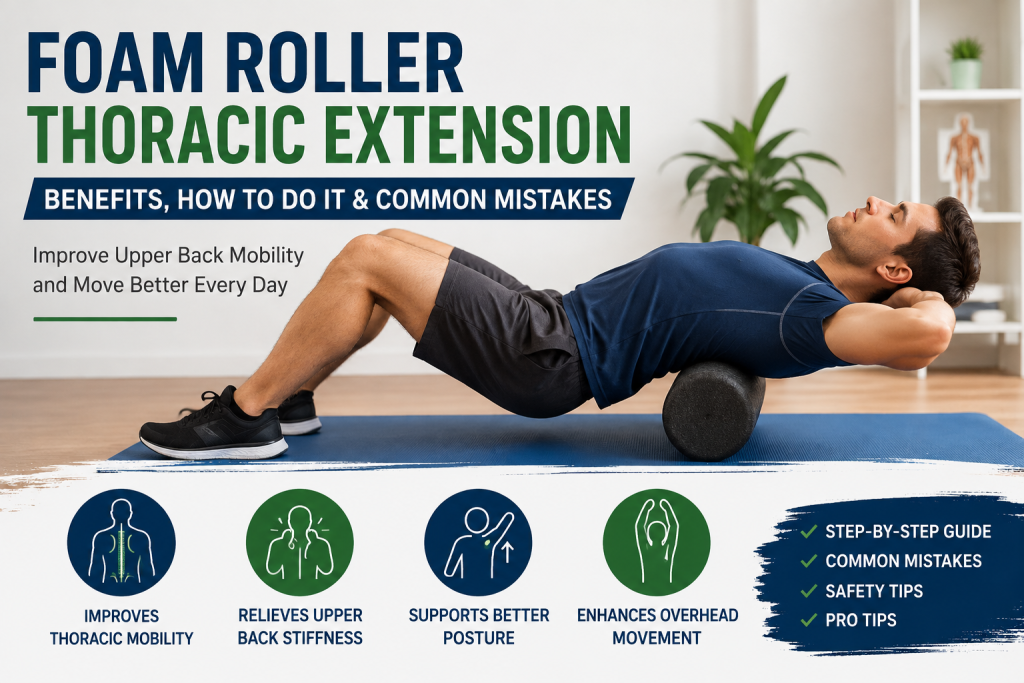
Foam Roller Thoracic Extension: Benefits, How to Do It & Common Mistakes
If your upper back feels stiff after long hours at a desk, driving, studying, or using a phone, gentle mobility work may help you move more comfortably. One simple exercise often used for thoracic mobility is Foam Roller Thoracic Extension. It uses a foam roller as a support point while you gently move the middle and upper portion of the spine into extension.
The thoracic spine is the section of the spine that runs through the upper and middle back. Because this area is involved in posture, rib movement, and shoulder mechanics, limited mobility can affect how comfortably you perform everyday movements and overhead activities. Thoracic extension exercises are commonly included in mobility and rehabilitation programs for this reason.
This guide explains how to perform the exercise, its potential benefits, common mistakes, useful modifications, and safety considerations. Foam Roller Thoracic Extension is best approached as a controlled mobility drill, not a forceful stretching technique.
What Is Foam Roller Thoracic Extension?
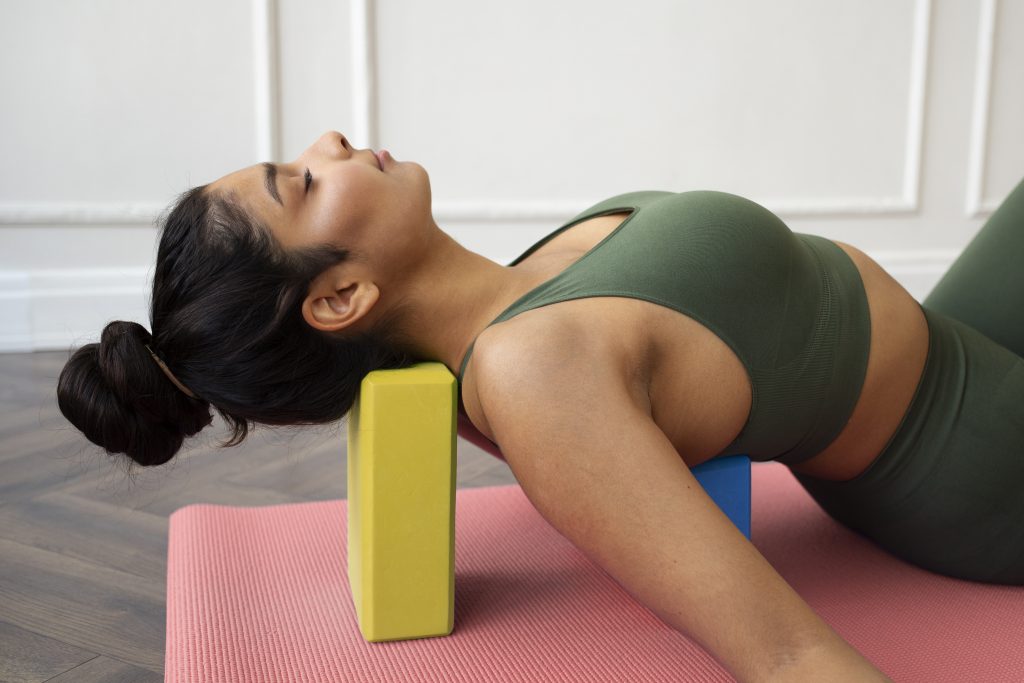
Foam Roller Thoracic Extension is a mobility exercise in which a foam roller is placed horizontally underneath the upper or middle back. You lie on your back with your knees bent and feet supported on the floor. Your hands support your head while you gently extend the upper back over the roller.
The roller acts as a pivot point. This can make it easier to focus the movement on the thoracic region instead of simply arching through the lower back. Exercise references commonly describe placing the roller around the mid-back or just below the shoulder blades and moving gradually through comfortable positions.
The movement should feel controlled and comfortable. You do not need to force your head toward the floor or create a dramatic arch. A small, smooth movement can be enough.
Why Thoracic Mobility Matters

The thoracic spine needs to move in several directions during normal activity. Extension is particularly relevant when you stand upright, reach overhead, lift your arms, or perform certain sporting movements. Thoracic mobility exercises are commonly used to develop movement in this region Foam Roller Thoracic Extension.
When the upper back feels restricted, people may compensate by moving more through other areas, such as the neck or lower back. Improving thoracic movement does not automatically fix every posture or pain problem, but it can be a useful part of a broader exercise program.
Benefits of Foam Roller Thoracic Extension
1. May Improve Upper-Back Mobility

A major reason people use Foam Roller Thoracic Extension is to practice controlled extension through the thoracic spine. Regular mobility work may help you move through a more comfortable range when stiffness is limiting movement.
2. Can Support Better Movement During Overhead Activities
Thoracic extension contributes to comfortable overhead positioning. A more mobile upper back may make movements such as reaching, lifting, and some gym exercises feel smoother. Thoracic extension mobility has also been discussed in relation to shoulder flexion and overhead movement.
3. May Reduce the Feeling of Upper-Back Stiffness

If your upper back feels tight after prolonged sitting, a gentle mobility exercise can be a useful movement break. It should not be treated as a guaranteed treatment for pain, but it may help some people feel less restricted Foam Roller Thoracic Extension.
4. Can Complement Posture-Focused Exercise
Long periods of sitting often place people in a sustained forward position. Thoracic mobility work can be combined with strengthening exercises for the upper back, shoulders, and trunk rather than being used as a stand-alone posture solution.
5. Useful as Part of a Warm-Up

Some exercise professionals include thoracic mobility drills before activities that require overhead movement. A short, controlled mobility sequence can help prepare the upper back for exercise.
How to Do Foam Roller Thoracic Extension Correctly
Step 1: Choose a Suitable Surface
Place your foam roller on a firm, stable floor. Avoid performing the exercise on a surface that makes the roller unstable.
Step 2: Set Up Your Body

Sit on the floor with your knees bent and feet flat. Place the foam roller horizontally behind you. Slowly lower your upper back onto the roller so that it sits across the thoracic region, around the mid-back or just below the shoulder blades Foam Roller Thoracic Extension.
Do not place the roller directly under your neck. Also avoid using the exercise by deliberately placing the roller under the lower back.
Step 3: Support Your Head
Place your hands behind your head or use them to gently cradle your head. Your hands should support the neck rather than pulling the head forward or forcing it backward.
Step 4: Keep Your Hips Supported
Keep your feet firmly on the floor and your hips close to the ground. Light abdominal engagement can help prevent excessive movement through the lower back Foam Roller Thoracic Extension.
Step 5: Extend Slowly
Take a comfortable breath in. Then gently allow your upper back to extend over the roller. Your head and shoulders may move backward slightly, but the movement should come primarily from the upper and middle back.
Step 6: Pause Briefly

At the comfortable end of the movement, pause for a moment without bouncing or forcing the stretch. Then return to the starting position with control.
Step 7: Change the Roller Position
After several comfortable repetitions, you can move the roller slightly higher or lower along the thoracic area and repeat. Small adjustments can help you work through different sections of the upper back. Professional exercise resources also describe repositioning the roller to target different thoracic segments Foam Roller Thoracic Extension.
How Many Repetitions Should You Do?
There is no single number that is correct for everyone. A beginner can start with around 5–8 slow repetitions at one comfortable position and assess how the body responds. You can then gradually work through other thoracic positions.
Some exercise programs use short holds, while others use repeated controlled movements. Follow the instructions given by your physiotherapist if the exercise has been prescribed as part of rehabilitation.
Quality is more important than quantity. Ten controlled repetitions are generally more useful than many rushed repetitions performed with poor technique.
Common Mistakes to Avoid
1. Arching the Lower Back

One of the most common problems is allowing the lower back to create most of the movement. Foam Roller Thoracic Extension Keep your hips supported and gently engage your abdominal muscles so the exercise remains focused on the thoracic area.
2. Placing the Roller Too High
Do not place the roller directly beneath the neck. The exercise is intended for the thoracic region. If you are unsure about positioning, ask a physiotherapist to demonstrate the correct setup.
3. Forcing the Range
More movement is not always better. If you have to push hard to get your head close to the floor, reduce the range. The movement should be gentle and controlled.
4. Moving Too Quickly
Bouncing over the roller can make it harder to control the movement. Move slowly, pause briefly, and return smoothly Foam Roller Thoracic Extension.
5. Pulling on the Neck

If your hands are behind your head, avoid using your arms to pull your head forward or backward. Let your hands provide support while the upper back performs the movement.
6. Holding Your Breath
Try to breathe normally. Slow breathing can help you remain relaxed while moving through the comfortable range.
7. Using the Exercise Despite Sharp Pain
A mobility exercise should not be pushed through sharp, shooting, or worsening pain. Stop if the movement causes concerning symptoms.
Foam Roller Thoracic Extension for Desk Workers
People who spend much of the day sitting may notice stiffness around the upper back and shoulders. Adding short movement breaks throughout the day can be more useful than relying on one exercise session alone Foam Roller Thoracic Extension
You can perform a few gentle repetitions after a long period of sitting, provided the exercise is comfortable for you. It can also be combined with shoulder blade strengthening, chest mobility, walking, and regular changes in sitting position.
Remember that posture is not simply about holding one perfect position all day. Changing positions and moving regularly are important parts of healthy movement habits.
Foam Roller Thoracic Extension for Athletes
Athletes may use thoracic mobility exercises as part of a warm-up or mobility routine. Upper-back movement can be relevant to activities that involve reaching, throwing, pressing, pulling, or overhead positions. Foam Roller Thoracic Extension.
However, mobility should match the demands of the activity. If you have an injury, persistent pain, or a significant restriction in movement, an individualized assessment is more appropriate than simply adding more repetitions.
A useful routine may combine thoracic mobility with active exercises such as wall slides, controlled thoracic rotations, or upper-back strengthening. This helps train the body to use the available range rather than relying only on passive stretching.
When Should You Avoid This Exercise?
Foam Roller Thoracic Extension is not appropriate for everyone. Avoid or modify it if you have been advised by a healthcare professional not to perform spinal extension exercises.
Extra caution is appropriate if you have a recent spinal injury, suspected fracture, significant osteoporosis, recent spinal surgery, or unexplained severe pain. Professional exercise guidance also recommends stopping when an exercise produces sharp or shooting pain.
If you experience numbness, weakness, dizziness, chest symptoms, unusual shortness of breath, or other concerning symptoms during exercise, stop and seek appropriate medical advice.
This article is for general educational purposes and does not replace an individual assessment by a qualified physiotherapist or other healthcare professional.
How to Make the Exercise Easier
If the foam roller feels too firm or the movement feels uncomfortable, you can reduce the range of motion. A rolled towel may also provide a gentler alternative for some beginners.
You can also place your arms across your chest instead of keeping your hands behind your head. This may reduce the leverage and make the movement feel more controlled Foam Roller Thoracic Extension.
Start with a small range and gradually increase it only if the movement remains comfortable.
How to Progress the Exercise
Once you can perform the basic movement comfortably, progression should still be gradual. You can work through several thoracic positions or combine the mobility exercise with active upper-back exercises.
Rather than chasing a deeper stretch, focus on smoother control and better awareness of where the movement occurs.
For long-term mobility, it is useful to combine passive mobility exercises with active strength and movement training. A foam roller can help you practice a range, but strengthening the muscles that control your posture and upper-body movement can help you use that range during daily activities.
Frequently Asked Questions
Is Foam Roller Thoracic Extension Good for a Stiff Upper Back?
It can be a useful mobility exercise for people who feel stiffness in the thoracic region, provided it is comfortable and appropriate for them. It should not be considered a universal treatment for upper-back pain.
How Often Can I Perform It?
Frequency depends on your goals, symptoms, and overall exercise program. A few controlled repetitions can be included in a mobility routine, but people recovering from an injury should follow individualized professional guidance.
Should My Lower Back Move During the Exercise?
The goal is to emphasize movement through the thoracic spine. Some natural movement may occur, but excessive lower-back arching means you may be compensating for limited thoracic movement.
Can I Use a Rolled Towel Instead of a Foam Roller?
Yes. A firmly rolled towel can be a gentler option when a foam roller feels too intense. It may be useful for beginners who are learning the movement.
Can This Exercise Fix Poor Posture?
No single exercise can guarantee a permanent posture change. Thoracic mobility can be one part of a broader approach that includes strengthening, movement habits, workstation adjustments, and regular activity.
Final Thoughts
Foam Roller Thoracic Extension can be a simple addition to a mobility routine when performed with good control. The main goal is to gently encourage movement through the upper and middle back without forcing the neck or lower back.
Start with a comfortable range, breathe normally, and focus on smooth movement. When practiced consistently and appropriately, Foam Roller Thoracic Extension can be a practical addition to an upper-back mobility routine.
If you have pain, an injury, or a medical condition affecting your spine, get personalized advice before adding the exercise to your routine.
For better long-term results, consider combining thoracic mobility with active strengthening and regular movement throughout the day. A physiotherapist can help determine which exercises are most appropriate for your individual needs.