
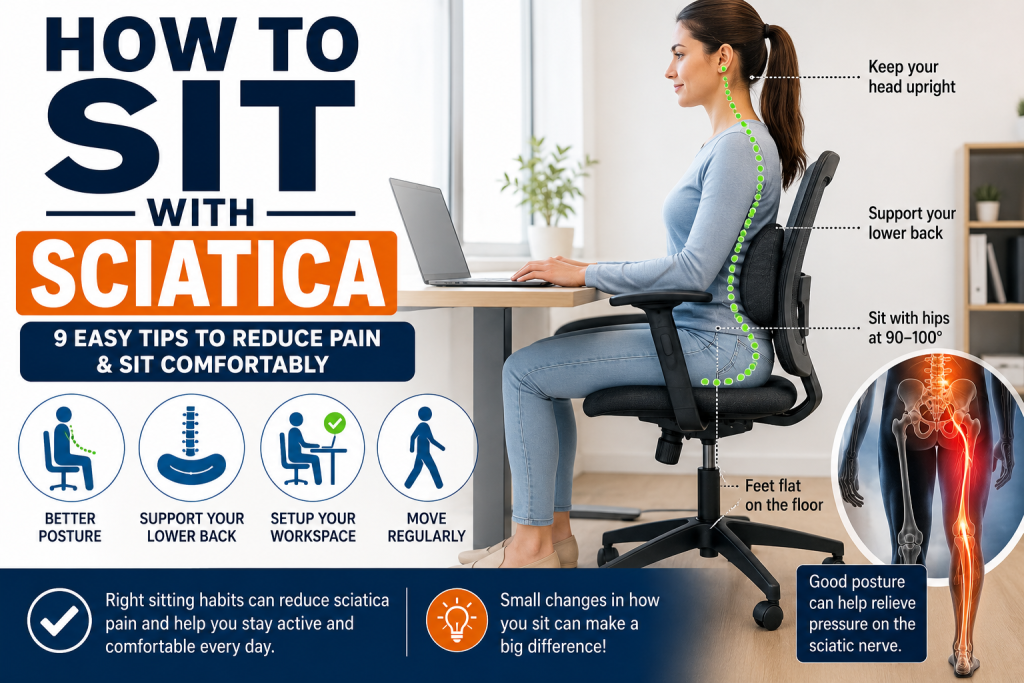
How to Sit With Sciatica: 9 Easy Tips to Reduce Pain & Sit Comfortably
If sitting makes your leg, buttock, or lower back pain worse, learning how to sit with sciatica can make everyday life much more comfortable. Sciatica typically refers to pain that travels along the path of the sciatic nerve, which runs from the lower back through the buttock and down the leg. Symptoms may include pain, tingling, numbness, or weakness.
Sitting does not necessarily cause sciatica, but staying in one position for a long time can aggravate symptoms in some people. Your posture, chair setup, movement habits, and the way you get up and sit down can all influence how your back and legs feel.
The good news is that you do not necessarily need to stop sitting altogether. Instead, the goal is to find a comfortable position, avoid prolonged static postures, and keep your body moving regularly.
This guide explains how to sit with sciatica, which sitting positions may be more comfortable, what mistakes to avoid, and when you should consider getting professional medical advice.
What Is Sciatica?

Sciatica describes symptoms caused by irritation or compression of the sciatic nerve or its nerve roots. The sciatic nerve is the largest nerve in the body and travels from the lower spine into the buttocks and legs.
Sciatica often affects one side of the body. Some people experience sharp or burning pain, while others notice tingling, numbness, or weakness.
Common causes can include a herniated disc, narrowing around the spinal nerves, or other conditions affecting the lower spine.
Not every episode of leg pain is sciatica, however. A healthcare professional can help determine the likely cause when symptoms are persistent, severe, or unusual.
Why Does Sitting Make Sciatica Worse?

Before learning how to sit with sciatica, it helps to understand why sitting can sometimes increase symptoms.
When you sit for a prolonged period, your hips and lower back remain in a relatively fixed position. Depending on the chair and your posture, this may increase discomfort in the lower back or buttocks.
A poorly positioned chair may also encourage you to slouch, lean to one side, or keep your legs in an awkward position.
However, there is no single sitting posture that works perfectly for everyone with sciatica. A position that feels comfortable for one person may aggravate symptoms in another.
The most important principle is to avoid staying in one position for too long and to adjust your sitting position based on your symptoms.
How to Sit With Sciatica: 9 Easy Tips
1. Choose a Supportive Chair
One of the first steps in learning how to sit with sciatica is choosing a chair that supports your body.
A good chair should provide reasonable support for your lower back and allow your feet to rest comfortably on the floor.
Avoid chairs that are extremely soft or deep if they make it difficult to maintain a comfortable position. A chair that allows you to sit upright without excessive effort is usually a better option.
You do not need an expensive ergonomic chair to improve your sitting setup. Even a standard chair can become more comfortable with appropriate adjustments.
2. Keep Your Feet Supported
Place both feet comfortably on the floor when possible.
Your knees should generally remain around hip level or slightly lower, depending on what feels comfortable. Avoid sitting with one leg tucked underneath you for long periods if that position increases your symptoms.
If your feet do not reach the floor, consider using a small footrest.
Supporting your feet can help you feel more stable and may reduce the tendency to slide forward or twist your pelvis.
3. Support Your Lower Back

A small lumbar cushion or rolled towel can provide additional support if your chair does not adequately support your lower back.
Place it around the natural curve of your lower spine rather than pushing it too far upward.
The goal is comfort—not forcing your spine into a rigid position.
If the cushion causes more pain, remove it or adjust its position. How to sit with sciatica is ultimately about finding a position that reduces aggravation while allowing you to sit naturally.
4. Avoid Prolonged Slouching
Slouching can be comfortable for short periods, but maintaining a rounded posture for a long time may aggravate symptoms in some people.
Try to keep your head, shoulders, and trunk reasonably aligned without becoming stiff.
You do not need to sit perfectly straight every second. In fact, constantly holding yourself rigid can create unnecessary muscle tension.
Instead, change positions regularly and find a relaxed posture that feels comfortable.
5. Take Frequent Movement Breaks

One of the most useful strategies for people learning how to sit with sciatica is to avoid sitting continuously for long periods.
Stand up, walk around, gently change position, or perform comfortable movements throughout the day.
If you work at a desk, consider setting a reminder to move regularly.
Even short movement breaks can make sitting more manageable.
Clinical guidance for low back pain and sciatica generally emphasizes staying active and continuing normal activities where possible rather than remaining inactive for prolonged periods. NICE: Low back pain and sciatica recommendations
6. Keep Your Screen at a Comfortable Height
If you sit at a computer, your workstation can influence your overall posture.
Position your monitor so you can view it without constantly bending your neck forward. Keep your keyboard and mouse close enough that you do not need to reach excessively.
If you repeatedly lean forward toward the screen, your lower back may also become uncomfortable.
A comfortable workstation makes it easier to maintain a relaxed sitting position.
7. Avoid Crossing Your Legs for Long Periods
Crossing your legs is not automatically harmful, but staying in a twisted or uneven position for a long time may increase discomfort in some people.
If you notice that crossing your legs increases symptoms, keep both feet supported instead.
You can also change positions periodically rather than maintaining the same leg position throughout the day.
8. Sit Down and Stand Up Carefully
How you transition into and out of a chair can also matter.
When sitting down, move close to the chair, bend through your hips and knees, and lower yourself in a controlled manner.
When standing, place your feet securely on the floor and rise smoothly rather than twisting suddenly.
If you experience severe pain while moving from sitting to standing, avoid forcing the movement and consider seeking professional assessment.
9. Find Your Most Comfortable Sitting Position
There is no universal “perfect” sitting posture for everyone with sciatica.
Some people feel better sitting upright with lumbar support. Others may prefer a slightly reclined position. Your symptoms may also change depending on the underlying cause of your sciatica.
Therefore, learning how to sit with sciatica involves paying attention to your body’s response.
If a position consistently increases leg pain, tingling, or numbness, change position rather than trying to tolerate it for hours.
Is It Better to Sit Upright or Reclined With Sciatica?
Many people assume that sitting perfectly upright is always best. That is not necessarily true.
A slightly reclined position may feel more comfortable for some people because it can reduce the effort required to maintain the posture.
Others may prefer sitting more upright.
The key is not to force yourself into one specific position. Experiment with small adjustments and choose the position that allows you to remain comfortable without increasing your symptoms.
Should You Sit on a Hard or Soft Chair?
Extremely soft couches can make it difficult to get up and may encourage you to sink into a rounded posture.
On the other hand, an extremely hard chair may create pressure around the buttocks and hips.
A moderately supportive chair is often more practical.
If your current chair feels uncomfortable, try a supportive cushion or adjust the seat height before purchasing expensive equipment.
How Long Should You Sit With Sciatica?
There is no universal time limit that applies to every person.
Instead of focusing on a specific number of minutes, pay attention to your symptoms.
If pain or numbness gradually increases while sitting, that is a sign to change position or stand and move around.
If your work requires long periods at a desk, alternate between sitting, standing, and walking when possible.
Regular movement is generally preferable to staying completely still for prolonged periods.
Best Sleeping Position if Sitting Is Also Painful
Although this article focuses on sitting, sleep can also affect how your back feels during the day.
Some people find side sleeping with a pillow between the knees comfortable. Others prefer lying on their back with a pillow under the knees.
There is no single sleeping position that is best for everyone.
Choose the position that allows you to sleep comfortably without increasing your symptoms.
If getting out of bed causes pain, roll onto your side first, bring your legs toward the edge of the bed, and use your arms to help push yourself up rather than suddenly bending forward.
Gentle Exercises That May Help
Learning how to sit with sciatica is only one part of managing symptoms. Appropriate physical activity may also help.
Walking
Gentle walking can help you remain active without keeping your spine in one position for a prolonged period.
Start with a comfortable distance and increase gradually if walking does not aggravate your symptoms.
Gentle Mobility
Some people benefit from gentle lower-back and hip movements.
However, exercises should be selected according to the person’s symptoms. A movement that helps one person may aggravate another.
Core and Hip Strengthening
Once acute symptoms settle, strengthening exercises may help improve general movement capacity.
A physiotherapist can recommend exercises based on your symptoms, strength, mobility, and daily activities.
Avoid performing advanced exercises simply because they are advertised as “sciatica exercises.” Proper assessment is more useful than following a generic routine.
Sitting Mistakes to Avoid
If you are trying to understand how to sit with sciatica, avoid these common mistakes.
Staying in One Position Too Long
Even a comfortable position can become uncomfortable when maintained for too long.
Using a Chair That Is Too Low
A very low chair can make getting up difficult and may increase hip and back discomfort.
Sitting on a Wallet or Bulky Object
Keeping a thick wallet or object in a back pocket can create an uneven sitting surface and may be uncomfortable.
Consider removing bulky items before sitting for long periods.
Leaning to One Side
Repeatedly leaning to one side can create an uneven posture. Change positions and distribute your weight comfortably.
Ignoring Increasing Symptoms
Do not force yourself to remain seated if your symptoms are clearly worsening.
Stand, walk, or change position when appropriate.
Can a Standing Desk Help Sciatica?
A standing desk may be useful for some people who find prolonged sitting uncomfortable, but standing continuously is not necessarily better.
The goal is to alternate between different positions.
If you use a standing desk, keep your monitor and keyboard at a comfortable height and avoid locking your knees or leaning heavily to one side.
Short periods of standing combined with walking and sitting may provide a more practical routine than remaining in one position all day.
When Should You See a Physiotherapist?
If your sciatica symptoms are persistent, recurrent, or interfering with work, sleep, walking, or normal activities, consider getting assessed by a qualified healthcare professional.
A physiotherapist can evaluate your:
- Lower-back movement
- Hip mobility
- Muscle strength
- Walking pattern
- Sitting and standing habits
- Exercise technique
- Neurological symptoms
They can then develop an individualized management plan.
Professional assessment is particularly useful when you have tried changing your sitting habits but your symptoms continue.
When Sciatica Requires Urgent Medical Attention
Most cases of sciatica do not require emergency treatment, but certain symptoms should not be ignored.
Seek urgent medical assessment if you develop new loss of bladder or bowel control, numbness around the genital or saddle region, significant or worsening weakness in the legs, or severe symptoms following major trauma.
You should also seek medical advice if symptoms are rapidly worsening or you are concerned about a serious underlying condition.
Do not assume that severe neurological symptoms are simply the result of poor sitting posture.
Frequently Asked Questions
What is the best way to sit with sciatica?
The best sitting position varies between individuals. A supportive chair, comfortable lower-back support, feet resting securely, and regular movement breaks are useful starting points.
Is sitting bad for sciatica?
Sitting is not automatically bad for sciatica. However, prolonged sitting can aggravate symptoms in some people. Changing position and remaining physically active can help make sitting more manageable.
Should I use a lumbar support cushion?
A lumbar cushion can be helpful if it makes your sitting position more comfortable. It should support your natural lower-back curve without forcing you into an uncomfortable posture.
Can I sit on a couch with sciatica?
You can, but very soft or deep couches may make it harder to maintain a comfortable position and get back up. If your couch aggravates your symptoms, choose a more supportive chair.
Should I stretch while sitting?
Gentle movements can be useful, but avoid aggressive stretching if it increases your leg pain, tingling, or numbness. A physiotherapist can help determine which exercises are appropriate for you.
Does walking help sciatica?
Gentle walking can help many people remain active while avoiding prolonged sitting. However, if walking significantly increases your symptoms, stop and seek professional advice.
How quickly can sciatica improve?
Recovery varies depending on the underlying cause, severity, and individual factors. Some episodes improve with time and appropriate self-management, while persistent symptoms may require professional evaluation.
Final Thoughts
Learning how to sit with sciatica can help you manage everyday discomfort and make work, driving, studying, and relaxing more comfortable.
Start with a supportive chair, keep your feet comfortably supported, avoid prolonged slouching, and take regular movement breaks. Most importantly, do not feel that you have to maintain one “perfect” posture all day. Comfortable movement and regular position changes are often more practical.
If your symptoms continue, worsen, or interfere with your normal activities, consider speaking with a qualified healthcare professional or physiotherapist. Sciatica can have different causes, so treatment should be based on your individual symptoms rather than sitting posture alone.