9 Powerful Vestibular Exercises for Vertigo That Can Improve Balance
Vertigo can make ordinary movements feel difficult. Turning your head, getting out of bed, walking through a busy room, or looking up can sometimes trigger a spinning or unsteady sensation. When dizziness continues or affects daily activities, appropriate rehabilitation may help improve balance, movement confidence, and tolerance to motion.
Vestibular exercises for vertigo are part of a rehabilitation approach designed to help the brain and balance system work together more effectively. Vestibular rehabilitation may include eye and head exercises, balance training, walking activities, and other movements selected according to the person’s symptoms and diagnosis.
This guide explains several commonly used exercise categories and how they may support balance. However, vertigo can have different causes, so an exercise that is appropriate for one person may not be appropriate for another.
What Is Vertigo?
Vertigo is a sensation that you or your surroundings are moving when there is no actual movement. Some people describe it as spinning, while others feel as though they are being pulled, tilted, or pushed off balance.
Your balance system receives information from several sources, including the inner ear, eyes, brain, and sensory receptors in your muscles and joints. The brain combines these signals to help you understand where your body is in space. Problems affecting one or more parts of this system can contribute to dizziness or imbalance.
Common conditions associated with dizziness or vestibular problems include benign paroxysmal positional vertigo (BPPV), vestibular neuritis, labyrinthitis, vestibular migraine, and some forms of reduced vestibular function. Treatment depends on the underlying cause.
How Vestibular Rehabilitation May Help
Vestibular rehabilitation is an exercise-based approach used to manage dizziness and balance difficulties. A trained healthcare professional can assess balance, walking, visual stability, head movement, and other factors before developing an exercise program.
The purpose is not simply to make someone exercise more. Instead, exercises can gradually challenge the balance system so that the brain becomes better at processing information from the eyes, inner ears, and body.
Depending on the person’s condition, rehabilitation may help reduce dizziness, improve balance, improve visual stability, increase confidence with movement, and reduce fall risk.
9 Vestibular Exercises for Vertigo and Balance
1. Gaze Stabilization Exercise
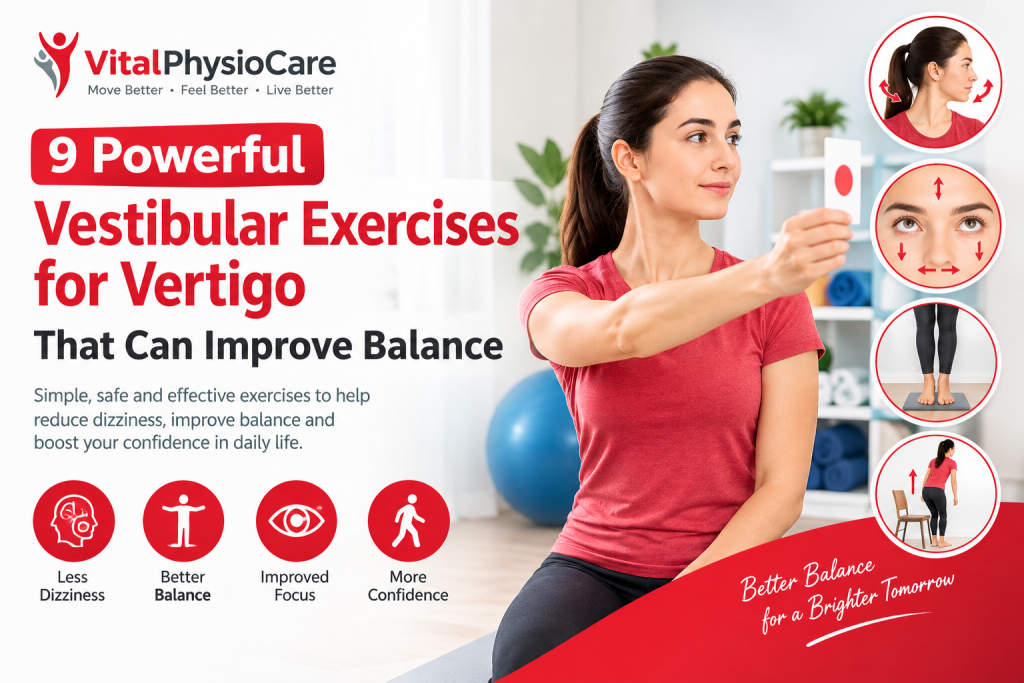
Gaze stabilization is commonly used in vestibular rehabilitation. The basic idea is to keep your eyes focused on a stationary target while gently moving your head.
Sit comfortably and choose a small object or letter on a wall. Keep your eyes focused on the target while slowly turning your head from side to side. Start with small movements and increase the range gradually if your symptoms remain manageable.
You can also perform a gentle up-and-down head movement while maintaining your focus on the target.
The purpose is to train coordination between head movement and visual stability. Cleveland Clinic describes gaze stabilization as an example of eye movement control used in vestibular rehabilitation.
2. Seated Head-Turning Exercise
Sit on a stable chair with your feet supported on the floor. Slowly turn your head to the right and then return to the middle. Repeat toward the left.
The movement should be controlled rather than fast or forceful.
As your tolerance improves, your physiotherapist may gradually increase the speed or difficulty. The aim is to help your balance system become more comfortable with head movement.
If a particular movement produces severe symptoms, stop and discuss it with a healthcare professional rather than repeatedly pushing through intense dizziness.
3. Eye Movement Exercises
Eye movement exercises can be used as part of a broader vestibular rehabilitation program.
While keeping your head still, slowly move your eyes up and down. Then move them from side to side. Keep your movements controlled and avoid straining your eyes.
Hospital vestibular rehabilitation guidance includes eye movement activities among exercises used to challenge the balance system.
These exercises are simple, but they should still be performed in a safe environment, particularly if dizziness is easily triggered.
4. Feet-Together Balance Exercise
Balance training is another important part of vestibular rehabilitation.
Stand near a sturdy surface such as a countertop or stable support. Place your feet closer together while maintaining an upright posture. Hold the position for a short period and use support when necessary.
As balance improves, a physiotherapist may progress the exercise by reducing the amount of support or changing your foot position.
Do not begin challenging balance exercises in an open area where a fall could cause injury.
5. Sit-to-Stand Practice
Sit-to-stand movements combine balance, leg strength, and everyday functional movement.
Start with a stable chair. Sit comfortably with both feet positioned securely on the floor. Lean slightly forward and stand up in a controlled manner. Pause briefly, then slowly sit back down.
This movement can be useful because getting up from a chair is part of everyday life. Vestibular rehabilitation programs may include strengthening and functional exercises alongside balance activities.
If you feel unstable, use a stable support and have someone nearby when appropriate.
6. Walking With Gentle Head Movements
Walking exercises can gradually challenge the balance system.
Begin in a safe, uncluttered area. Walk slowly while looking forward. If a healthcare professional has determined that this is appropriate for you, you may eventually practice gentle head movements while walking.
Vestibular rehabilitation can include walking tasks at different speeds, head movements, and navigation around obstacles.
This type of exercise should be progressed gradually. If walking with head movement causes significant instability, return to an easier variation.
7. Standing Head Movements
Once seated exercises are comfortable, some people may progress to controlled head movements while standing.
Stand close to a stable surface. Slowly turn your head from side to side and return to the center. Then, if appropriate, practice gentle up-and-down movements.
The goal is to challenge the balance system without creating an unsafe situation.
A vestibular rehabilitation program should become progressively more difficult as the person improves. NHS guidance notes that exercises can be progressed by changing position, increasing repetitions or speed, or making the visual task more challenging.
8. Gentle Weight-Shifting
Weight-shifting exercises can help you become more comfortable controlling your body position.
Stand with your feet at a comfortable width and hold a stable support if needed. Slowly shift your weight toward one side and then return to the middle. Repeat toward the opposite side.
Keep the movement small at first.
As your balance improves, a physiotherapist may introduce more challenging variations. The exercise should never require you to risk falling.
9. Controlled Turning and Direction Changes
Turning is an important real-life movement because people constantly change direction while walking.
Start by standing near a stable support. Practice slowly turning your body and taking small steps rather than making a sudden pivot.
Once this feels easier, controlled direction changes can be incorporated into walking practice.
Vestibular rehabilitation programs may include gait training and walking activities because balance difficulties often become noticeable during movement rather than simply while standing still.
How Often Should You Do Vestibular Exercises?
There is no single exercise schedule that is correct for everyone. The frequency, duration, intensity, and progression should depend on the underlying condition and the person’s response.
Some NHS vestibular rehabilitation programs provide exercises multiple times per day, while other programs use different schedules. This is one reason it is better not to copy another person’s exact routine without professional guidance.
Consistency is generally more important than suddenly doing a large amount of exercise.
A simple approach is to start with an appropriate, manageable exercise and gradually progress according to professional guidance.
Should Vestibular Exercises Make You Dizzy?
Some vestibular exercises are specifically designed to challenge movements that trigger mild dizziness or imbalance. A temporary increase in symptoms can occur during rehabilitation because the balance system is being challenged.
However, there is an important difference between a manageable exercise response and severe symptoms.
If an exercise causes intense or prolonged dizziness, significant pain, visual changes, numbness, or another concerning symptom, stop the exercise and seek appropriate medical advice. NHS patient guidance also recommends performing these exercises in a safe environment and stopping when concerning symptoms occur.
Safety Tips Before Trying Vestibular Exercises
Safety should come before progression.
Perform balance exercises near a stable support. Remove loose rugs and clutter from the exercise area. Avoid practicing challenging balance movements near stairs or other hazards.
If you are prone to falling, consider having another person nearby.
You should also avoid assuming that every episode of dizziness is suitable for home exercise. Dizziness can have many causes, and identifying the cause is an important part of choosing the right treatment.
The NHS recommends specialist supervision for vestibular rehabilitation in conditions such as labyrinthitis or vestibular neuritis when long-term balance problems remain.
When Should You See a Physiotherapist?
Consider professional assessment if dizziness keeps returning, affects walking, interferes with daily activities, or makes you afraid of moving.
A physiotherapist trained in vestibular rehabilitation can assess your symptoms and determine which exercises are appropriate. Assessment may include balance, walking, head movement, visual stability, and other functional tests.
Professional assessment is especially useful because not all dizziness has the same cause. Some people may benefit from gaze stabilization and balance training, while others may require a specific repositioning maneuver or treatment for another underlying condition.
Can Vestibular Exercises Cure Vertigo?
Vestibular exercises can help manage dizziness and balance problems, but they are not a universal cure for every cause of vertigo.
For example, some forms of positional vertigo may require specific repositioning treatment, while vestibular hypofunction may be managed with a rehabilitation program designed to improve adaptation and balance.
The best treatment depends on the diagnosis.
The goal of rehabilitation is often to improve function and reduce the effect of dizziness on everyday life rather than simply eliminating every sensation immediately.
Lifestyle Habits That May Support Recovery
Exercise is only one part of managing balance problems.
Try to maintain a regular daily routine when your healthcare professional says it is safe. Avoid unnecessary inactivity caused by fear of movement, because prolonged avoidance can sometimes reduce confidence and physical conditioning.
Get enough rest, stay appropriately hydrated, and follow medical advice for any diagnosed condition.
If dizziness affects your ability to walk safely, make fall prevention a priority.
When Dizziness Needs Medical Attention
Most dizziness does not automatically mean there is a serious medical problem, but certain symptoms require urgent evaluation.
Seek urgent medical attention if severe or sudden dizziness occurs with symptoms such as new weakness, difficulty speaking, severe headache, fainting, significant chest pain, new severe vision problems, or difficulty coordinating movement.
Do not rely on home exercises to diagnose the cause of sudden or unexplained neurological symptoms.
Final Thoughts
Vestibular exercises for vertigo can be an important part of rehabilitation for people experiencing dizziness, imbalance, or reduced tolerance to movement. Exercises may include gaze stabilization, eye movements, balance training, walking practice, weight shifting, and controlled head movements.
The most important point is that vestibular rehabilitation should be individualized. Not every person with vertigo needs the same exercises, and some conditions require a specific medical or physiotherapy treatment.
If dizziness is persistent, recurrent, or affecting your ability to walk and perform normal activities, consider getting an assessment from an appropriate healthcare professional. A personalized program can help you progress safely while addressing the underlying cause of your symptoms.