9 Powerful Ankle Mobility Exercises to Improve Flexibility & Movement
Ankle mobility exercises can be a useful part of improving ankle movement, flexibility, balance, and everyday function. Your ankles play an important role in walking, climbing stairs, running, squatting, and many other activities. When ankle movement becomes limited, you may notice stiffness, difficulty squatting, changes in your walking pattern, or discomfort during exercise.
Limited ankle mobility can have several possible causes, including prolonged inactivity, previous ankle injuries, muscle tightness, joint stiffness, or spending long periods in the same position. The good news is that gentle mobility work can often help maintain or gradually improve your available range of motion.
This guide explains nine practical ankle mobility exercises that can be performed at home with little or no equipment. The exercises are suitable for many generally healthy adults, but they should be performed comfortably and should not cause sharp or worsening pain.
What Is Ankle Mobility?

Ankle mobility refers to how freely your ankle joint can move through its available range of motion. One particularly important movement is dorsiflexion, which occurs when you bring your toes and foot upward toward your shin.
Good ankle mobility can help you perform everyday movements more efficiently. For example, sufficient ankle movement can make it easier to walk normally, descend stairs, perform a squat, or maintain a stable position during exercise.
Mobility is different from flexibility. Flexibility generally refers to the ability of muscles and other soft tissues to lengthen, while mobility involves how well a joint can move and how the surrounding tissues allow that movement.
Why Is Ankle Mobility Important?
Your ankles work together with your feet, knees, hips, and other parts of the lower body. If ankle movement is restricted, your body may compensate by changing how another joint moves.
Improving or maintaining ankle mobility may help with:
- Comfortable walking
- Squatting and bending movements
- Stair climbing
- Exercise technique
- Balance and coordination
- General lower-body movement
However, mobility exercises are not a guaranteed treatment for every ankle problem. Persistent pain, swelling, instability, or significant movement restrictions may require assessment by a qualified healthcare professional.
9 Ankle Mobility Exercises to Try
The following exercises focus on gentle movement rather than forcing the ankle into a position. Start slowly and work within a comfortable range.
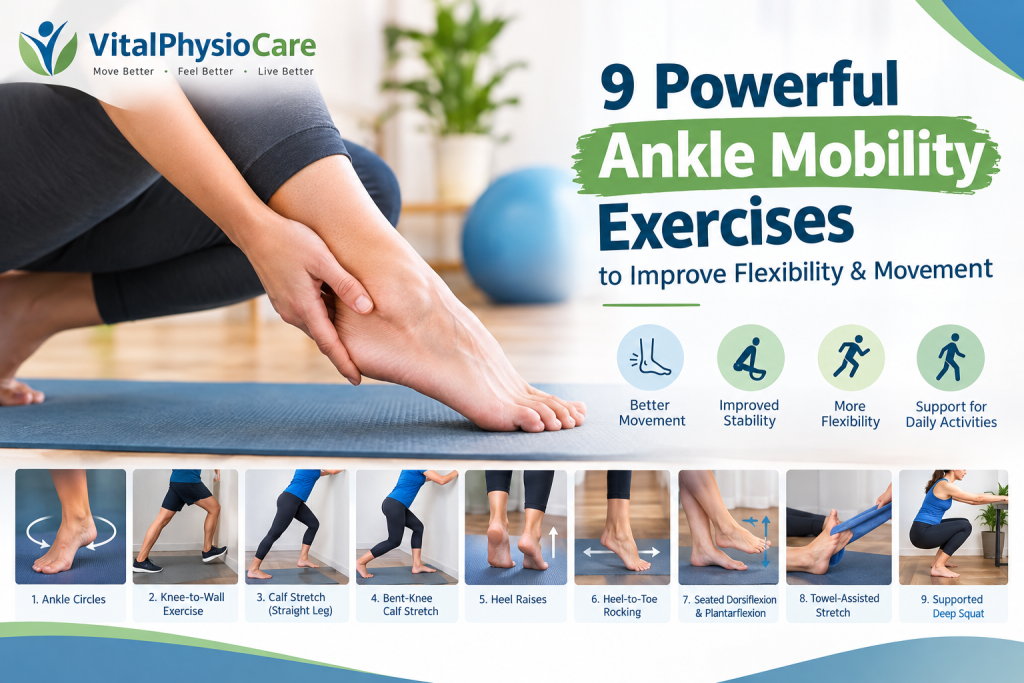
1. Ankle Circles

Ankle circles are a simple way to move the ankle through multiple directions.
Sit comfortably in a chair and extend one leg slightly in front of you. Slowly rotate your ankle in a circular motion. Make controlled circles without forcing the movement.
Perform approximately 8–10 circles in one direction, followed by 8–10 circles in the opposite direction. Repeat on the other ankle.
This exercise can be particularly useful as a gentle warm-up before more demanding mobility work.
2. Knee-to-Wall Ankle Mobility Exercise
The knee-to-wall movement is commonly used to work on ankle dorsiflexion.
Stand facing a wall with one foot positioned several inches away. Keep your heel on the floor and slowly move your knee forward toward the wall. Your knee should track generally in line with your foot rather than collapsing inward.
Move only as far as you can while keeping your heel down. Slowly return to the starting position.
Try 8–12 controlled repetitions on each side.
If your knee easily reaches the wall, gradually move the foot slightly farther away. The goal is controlled movement rather than forcing the knee forward.
3. Calf Stretch Against a Wall
Tight calf muscles can contribute to a feeling of restricted ankle movement. A gentle calf stretch can complement other mobility exercises.
Place both hands against a wall. Step one foot backward and keep that heel connected to the floor. Bend the front knee while keeping the rear leg relatively straight.
You should feel a gentle stretch through the calf of the rear leg. Hold the position for around 20–30 seconds, then relax.
Repeat 2–3 times on each side.
Do not bounce during the stretch, and avoid pushing into pain.
4. Bent-Knee Calf Stretch
The soleus muscle is one of the muscles located in the calf and contributes to ankle movement. A bent-knee calf stretch can place more emphasis on this area.
Stand facing a wall with one foot behind the other. Keep the rear heel on the floor and gently bend both knees while moving your body forward.
Hold the comfortable stretch for approximately 20–30 seconds. Repeat two or three times per side.
Using both straight-knee and bent-knee calf stretching can provide variety in your mobility routine.
5. Heel Raises
Heel raises are primarily a strengthening exercise, but they can also help you practice controlled ankle movement.
Stand near a wall, countertop, or sturdy chair for balance. Slowly raise your heels so that you come onto the balls of your feet. Pause briefly, then lower your heels with control.
Try 8–15 repetitions.
As your strength improves, you can gradually increase the number of repetitions. If balance is difficult, keep one or both hands supported.
Avoid using a surface that can move or tip over.
6. Heel-to-Toe Rocking
Heel-to-toe rocking allows you to practice shifting your weight through the foot and ankle.
Stand upright while holding a stable surface if necessary. Slowly shift your weight toward your toes, allowing your heels to lift slightly. Then move your weight backward toward your heels while keeping your movements controlled.
Perform 10–15 repetitions.
This exercise can help you become more comfortable with the ankle moving through different positions while bearing weight.
7. Seated Dorsiflexion and Plantarflexion
This is one of the easiest ankle mobility exercises for beginners because you can perform it while sitting.
Sit in a chair with your feet flat on the floor. Lift your toes and the front of your feet upward while keeping your heels down. Then gently point your toes downward.
Move slowly between the two positions.
Perform 10–15 repetitions on each foot.
This exercise can also be useful when you want a simple movement break after sitting for a long period.
8. Towel-Assisted Ankle Stretch
A towel can provide gentle assistance during ankle stretching.
Sit on the floor or on a firm surface with your leg extended. Place a towel or strap around the ball of your foot and hold both ends.
Gently pull the towel toward you while keeping your knee comfortable and relatively straight. Stop when you feel a mild stretch through the calf.
Hold for approximately 20–30 seconds and repeat two or three times.
The towel should assist the movement rather than force your ankle into an extreme position.
9. Supported Deep Squat Mobility
A supported squat can combine ankle movement with a functional lower-body position.
Stand in front of a stable support such as a sturdy table or railing. Hold the support and slowly lower yourself toward a comfortable squat position.
Keep your heels as close to the floor as comfortably possible. Do not force the depth of the squat.
Hold briefly and return to standing.
Try 5–10 controlled repetitions.
If you experience knee, hip, back, or ankle pain during the movement, stop and choose a gentler exercise instead.
How Often Should You Do Ankle Mobility Exercises?
The ideal frequency depends on your individual situation and the reason for your restricted movement.
For general mobility, a short routine performed several times per week may be easier to maintain than an occasional long session. You could begin with around 5–10 minutes of gentle mobility work and see how your body responds.
Consistency is more important than forcing large movements.
If you are recovering from an ankle injury or surgery, follow the rehabilitation plan provided by your healthcare professional rather than automatically following a general exercise routine.
When Should You Do These Exercises?
You can use mobility exercises at different points during the day.
Before exercise, gentle ankle movements can help prepare the joint for activity. During a workday, seated ankle movements can provide a simple movement break. After exercise, gentle stretching may feel comfortable for some people.
The important point is to match the exercise intensity to your current ability.
You should not need to push through sharp pain to improve mobility.
Common Mistakes to Avoid
One common mistake is forcing the ankle into a range of motion that feels painful. Mobility training should generally be controlled and gradual.
Another mistake is rushing through repetitions. Slow movements make it easier to maintain control and notice how your ankle responds.
Avoid bouncing aggressively during stretches. Instead, use steady movements and comfortable holds.
It is also important not to ignore significant symptoms. If your ankle repeatedly gives way, becomes very swollen, or remains painful, mobility exercises alone may not address the underlying problem.
Can Ankle Mobility Exercises Help After an Injury?
They can be part of rehabilitation for some ankle injuries, but the appropriate exercises depend on the injury and stage of recovery.
After an ankle sprain, for example, rehabilitation may involve a combination of mobility, strengthening, balance, and gradual return-to-activity exercises. Starting too aggressively can potentially aggravate symptoms.
If you recently injured your ankle, have significant swelling or bruising, cannot comfortably put weight on the foot, or have ongoing instability, consider getting an assessment from a physiotherapist or other qualified healthcare professional.
Tips for Better Results
Start with easy movements and gradually increase the challenge. You do not need to perform all nine exercises every day.
A simple routine could include ankle circles, knee-to-wall movements, calf stretching, heel raises, and supported squats. As your comfort and control improve, you can adjust repetitions or add other movements.
Pay attention to both ankles. One side may naturally feel different from the other, particularly after an old injury.
Good footwear can also matter during weight-bearing activities. Choose footwear that provides appropriate comfort and stability for the activity you are performing.
Most importantly, focus on gradual progress rather than trying to achieve maximum range immediately.
When to Seek Professional Help
Mobility exercises are not appropriate for every ankle problem. Seek professional assessment if you have severe or persistent pain, substantial swelling, repeated ankle instability, significant weakness, numbness, or difficulty putting weight through the foot.
An injury that does not improve as expected may also need further evaluation.
A physiotherapist can assess ankle movement, muscle strength, balance, walking mechanics, and other factors that may contribute to your symptoms. They can then develop an exercise program based on your specific needs.
Frequently Asked Questions
How long does it take to improve ankle mobility?
The timeframe varies from person to person. Factors such as the cause of restricted movement, previous injuries, consistency, strength, and overall activity level can affect progress. Regular, comfortable practice is generally more useful than occasionally forcing the ankle through a large range.
Can I do ankle mobility exercises every day?
Some gentle movements may be suitable for frequent practice, but your response matters. If an exercise causes increasing pain or swelling, reduce the intensity or stop and seek professional advice if symptoms persist.
Do ankle mobility exercises improve squatting?
They may help if limited ankle movement is one factor affecting your squat. However, squat technique also depends on hip mobility, strength, balance, body proportions, and individual movement patterns.
Should ankle exercises hurt?
They should not cause sharp or significant pain. A mild stretch or muscular effort can be normal, but worsening pain is a reason to stop and reassess the exercise.
Are ankle mobility exercises useful for runners?
They can be included in a broader mobility and strengthening routine for runners. However, running-related pain should not automatically be treated with mobility exercises alone. The underlying cause should be considered.
Final Thoughts
Healthy ankle movement supports many everyday activities, from walking and climbing stairs to squatting and exercising. Simple ankle mobility exercises such as ankle circles, knee-to-wall movements, calf stretches, heel raises, and controlled weight shifts can help you practice comfortable ankle movement.
The key is consistency, control, and gradual progression. Avoid forcing the joint and pay attention to symptoms. If you have persistent pain, swelling, instability, or a recent significant injury, professional assessment is more appropriate than relying solely on a general exercise routine.
With the right approach, a short mobility routine can become an easy addition to your daily movement habits and overall lower-body exercise program.