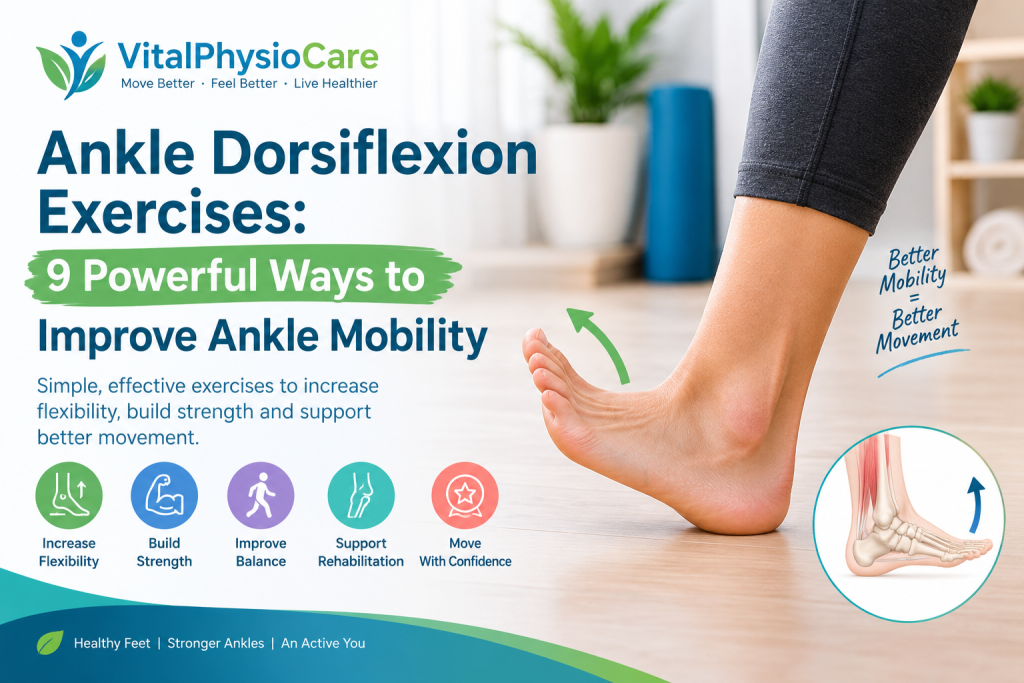
Ankle Dorsiflexion Exercises: 9 Powerful Ways to Improve Ankle Mobility
Ankle mobility plays an important role in walking, running, climbing stairs, squatting, and maintaining balance. When your ankle cannot bend comfortably upward, everyday movements may become more difficult. Limited ankle movement can also affect exercise technique and the way your body distributes weight during physical activities.
Ankle dorsiflexion exercises are designed to improve the ability to bring the top of your foot toward your shin. These movements can help maintain flexibility, develop ankle control, and support rehabilitation when appropriate. They may be particularly useful for people experiencing stiffness after periods of inactivity or following certain ankle injuries.
However, reduced ankle movement can have several causes, including calf tightness, joint stiffness, swelling, and previous injuries. The right approach depends on the underlying problem.
In this guide, you will learn nine practical ankle mobility exercises, how to perform them correctly, common mistakes to avoid, and when to seek professional advice.
What Is Ankle Dorsiflexion?
Ankle dorsiflexion is the movement that brings your toes upward toward your shin. For example, when you lift your toes off the floor while keeping your heel down, you are performing dorsiflexion.
This movement helps your ankle adapt during walking and allows your shin to move forward over your foot during activities such as squatting and climbing stairs.
Limited dorsiflexion may be associated with calf muscle tightness, ankle joint restrictions, previous sprains, swelling, or other musculoskeletal conditions. Identifying the cause is important because stretching alone may not resolve every problem.
According to the American Academy of Orthopaedic Surgeons, ankle conditioning programs can include mobility and strengthening exercises to support foot and ankle function.
Benefits of Ankle Dorsiflexion Exercises
When appropriately selected, ankle dorsiflexion exercises may help support several aspects of movement.
- Improved ankle mobility: Gentle movements can help maintain or gradually improve comfortable ankle movement.
- Better movement technique: Sufficient ankle mobility can make certain squatting, lunging, and stair-climbing movements easier.
- Calf flexibility: Some ankle stretches gently lengthen the calf muscles.
- Muscle control: Strengthening exercises help train the muscles responsible for lifting the front of the foot.
- Rehabilitation support: A suitable exercise program may help restore movement following certain injuries, depending on the stage of recovery.
- Everyday movement: Maintaining ankle mobility may make routine activities more comfortable.
Results vary depending on the cause of stiffness, exercise consistency, and individual recovery. These exercises do not guarantee injury prevention or replace treatment for an underlying medical condition.
9 Ankle Dorsiflexion Exercises to Improve Mobility
Start with gentle movements and use a comfortable range. The following exercises are general examples for adults without an injury that requires specific medical restrictions.
1. Seated Ankle Pumps
Seated ankle pumps are a simple starting point for moving the ankle without placing body weight through the foot.
How to perform the exercise:
- Sit comfortably in a chair with your feet supported.
- Extend one leg slightly if comfortable.
- Pull your toes upward toward your shin.
- Slowly point your toes away from your body.
- Repeat the movement smoothly without forcing the ankle.
Suggested starting amount: 10 repetitions per foot.
Why it helps: This movement takes the ankle through dorsiflexion and plantar flexion, helping maintain comfortable movement.
Tip: Keep the motion controlled rather than moving quickly. Reduce the range if you experience discomfort.
2. Towel-Assisted Calf Stretch
Tight calf muscles may contribute to restricted ankle movement in some people. A towel-assisted stretch allows you to gently stretch the calf while sitting.
How to perform the exercise:
- Sit on a firm surface with one leg extended.
- Loop a towel around the ball of your foot.
- Hold both ends of the towel.
- Gently pull the towel toward you until you feel a mild stretch in your calf.
- Keep your knee straight if comfortable and avoid pulling forcefully.
Suggested starting amount: Hold for 15–30 seconds and repeat two or three times, provided the stretch is comfortable.
Why it helps: The stretch targets the calf muscles and may help improve flexibility when muscle tightness contributes to restricted movement.
Tip: Do not bounce or force your foot toward your shin. Stop if you experience sharp pain, tingling, or increasing discomfort.
The Kaiser Permanente ankle rehabilitation guide provides additional guidance on ankle movement and towel-assisted calf stretching.
3. Knee-to-Wall Ankle Mobility Exercise
The knee-to-wall movement is a common way to practise ankle dorsiflexion while keeping the heel on the floor.
How to perform the exercise:
- Stand facing a wall with one foot positioned in front of the other.
- Place the front foot flat on the floor.
- Slowly move your front knee toward the wall.
- Keep your heel down and your knee aligned with your foot.
- Move only as far as you can without pain, then return to the starting position.
Suggested starting amount: Try 8–10 gentle repetitions per side.
Why it helps: This movement practises forward movement of the shin over the foot, which is important during several weight-bearing activities.
Tip: If your heel lifts, reduce the distance between your foot and the wall. Do not force the knee forward through pain.
If you have a recent ankle injury, significant swelling, or difficulty bearing weight, seek professional advice before attempting this exercise.
4. Standing Calf Stretch With a Straight Knee
This stretch primarily targets the gastrocnemius, one of the major calf muscles.
How to perform the exercise:
- Stand facing a wall and place both hands against it.
- Step one foot backward while keeping both feet pointed forward.
- Bend the front knee and keep the back knee straight.
- Keep the back heel in contact with the floor.
- Lean forward gently until you feel a stretch in the back of your lower leg.
Suggested starting amount: Hold for 15–30 seconds and repeat two or three times per side.
Why it helps: Improving calf flexibility may make upward ankle movement more comfortable when muscle tightness is a contributing factor.
Tip: Maintain a comfortable stretch instead of pushing your heel down aggressively.
5. Standing Calf Stretch With a Bent Knee
The soleus is another important calf muscle. Bending the knee during a calf stretch changes which parts of the calf are emphasised.
How to perform the exercise:
- Stand facing a wall for support.
- Place one foot behind you.
- Keep the back heel on the floor.
- Slightly bend the back knee while leaning forward.
- Stop when you feel a gentle stretch in the lower calf.
Suggested starting amount: Hold for 15–30 seconds and repeat two or three times if comfortable.
Why it helps: The exercise targets the calf with the knee bent and may complement straight-knee stretching.
Tip: Avoid twisting your foot outward to increase the stretch. Keep the movement controlled and comfortable.
6. Active Ankle Dorsiflexion
This exercise focuses directly on the muscles that lift the front of your foot.
How to perform the exercise:
- Sit on a chair or lie down with your leg supported.
- Keep your heel resting on the floor or another comfortable surface.
- Pull your toes and the front of your foot toward your shin.
- Pause briefly at the top of the movement.
- Slowly return your foot to the starting position.
Suggested starting amount: Perform 8–12 repetitions per foot.
Why it helps: Active movement practises ankle control and uses the muscles involved in dorsiflexion.
Tip: Avoid lifting your entire leg or making sudden movements. If you have new foot weakness or difficulty lifting your toes, seek medical assessment rather than relying on exercise alone.
7. Resistance Band Ankle Dorsiflexion
Once unresisted ankle movement feels comfortable, a resistance band may provide a way to strengthen the muscles that lift the foot.
How to perform the exercise:
- Sit with your leg extended or supported comfortably.
- Place an exercise band around the front of your foot.
- Secure the other end to a stable anchor in front of you.
- Pull your toes toward your shin against the band’s resistance.
- Return slowly to the starting position.
Suggested starting amount: Try 8–12 repetitions with light resistance, provided the movement is comfortable.
Why it helps: The exercise challenges the muscles responsible for dorsiflexion and can be included in suitable ankle-strengthening programs.
Tip: Check that the band and anchor are secure before starting. Use light resistance and avoid jerking your foot backward.
The AAOS Foot and Ankle Conditioning Program describes resistance-band exercises for ankle dorsiflexion and plantar flexion.
8. Gentle Ankle Circles
Ankle circles move the foot in multiple directions. They are useful for practising general ankle mobility, although they do not isolate dorsiflexion.
How to perform the exercise:
- Sit comfortably with your leg supported.
- Lift your foot slightly if this is comfortable.
- Slowly move your foot in a circular direction.
- Complete several circles, then change direction.
- Keep the movement within a comfortable range.
Suggested starting amount: Perform 5–10 circles in each direction per ankle.
Why it helps: Ankle circles encourage controlled movement through different directions and can form part of a gentle mobility routine.
Tip: Make small circles initially. Avoid this movement if it aggravates a recent injury or causes pain.
9. Supported Heel-to-Toe Weight Shifts
This exercise introduces gentle weight-bearing movement and should only be attempted if you can stand comfortably and have no medical restriction on putting weight through your foot.
How to perform the exercise:
- Stand beside a wall or sturdy counter.
- Place both feet flat on the floor, approximately hip-width apart.
- Keep your hands near the support for balance.
- Gently shift your weight forward so your shins move slightly over your feet.
- Return to the starting position without lifting your heels.
- Repeat with small, controlled movements.
Suggested starting amount: Perform 8–10 repetitions.
Why it helps: The exercise practises ankle movement during a supported standing activity.
Tip: Do not force your ankle into a deep stretch. Stop if you experience pain, instability, or increasing swelling.
How Often Should You Perform Ankle Dorsiflexion Exercises?
The appropriate frequency depends on your symptoms, current mobility, injury history, and the type of exercise.
For general mobility, you might begin with a small selection of gentle exercises rather than performing all nine at once. Start with one set of comfortable repetitions and increase gradually if your ankle responds well.
A simple routine could include:
| Exercise | Starting amount |
|---|---|
| Seated ankle pumps | 10 repetitions |
| Towel-assisted calf stretch | 15–30 seconds |
| Knee-to-wall mobility | 8–10 repetitions |
| Active ankle dorsiflexion | 8–12 repetitions |
| Gentle ankle circles | 5–10 in each direction |
These amounts are examples, not a personalised rehabilitation prescription. You do not need to complete every exercise every day. If you are recovering from surgery, a fracture, or an ankle sprain, follow the schedule provided by your healthcare professional.
Common Mistakes to Avoid
Even simple ankle exercises can become uncomfortable when performed incorrectly.
Forcing the ankle: Pushing into sharp pain or trying to achieve a larger stretch too quickly can aggravate symptoms.
Lifting the heel during mobility drills: In exercises designed to keep the heel down, lifting it changes the movement being practised.
Using excessive resistance: A heavy resistance band can make it difficult to control the return movement. Begin with light resistance.
Ignoring swelling: Increasing swelling, warmth, or pain may indicate that the activity is not appropriate at that time.
Expecting immediate results: Mobility changes vary between individuals. Progress may be gradual, especially after an injury.
Choosing exercises without considering the cause: Joint restrictions, tendon problems, fractures, and other conditions may require different approaches.
When Should You Avoid These Exercises?
Do not begin a new ankle exercise routine without professional guidance if you have a suspected fracture, a recent serious injury, substantial swelling, or instructions to restrict movement or weight-bearing.
Seek urgent medical assessment if you cannot bear weight after an injury, have severe pain or deformity, or develop a suddenly cold, pale, numb, or unusually discoloured foot. A hot, red, increasingly swollen ankle, particularly with fever, also requires prompt assessment.
If your ankle stiffness persists, repeatedly returns, or limits walking, consult a qualified physiotherapist or healthcare professional. They can assess your range of motion, strength, balance, and the possible cause of your symptoms.
Frequently Asked Questions
1. What are the best ankle dorsiflexion exercises for beginners?
Seated ankle pumps, active ankle dorsiflexion, and gentle calf stretches are possible starting options for people without injury-related restrictions. The most suitable exercises depend on why ankle movement is limited.
2. Can ankle dorsiflexion exercises improve squatting?
They may help if limited ankle mobility is contributing to difficulty squatting. However, squat technique also depends on hip mobility, strength, balance, body proportions, and movement control.
3. How long does it take to improve ankle mobility?
There is no single timeline. Progress depends on the cause and severity of the restriction, the exercises selected, and consistency. Recovery after an injury may require an individually planned rehabilitation program.
4. Should ankle exercises hurt?
They should not cause sharp or worsening pain. Stop an exercise if it significantly increases pain or swelling. Seek professional guidance if symptoms persist.
5. Are resistance bands necessary?
No. Many people can begin with unresisted ankle movements and comfortable stretches. Resistance bands may be useful for strengthening when appropriate, but they are not essential for every mobility program.
Conclusion
Ankle dorsiflexion is important for comfortable walking, squatting, stair climbing, and many everyday activities. Appropriate ankle dorsiflexion exercises can help practise ankle movement, stretch tight calf muscles, and strengthen the muscles that lift the foot.
Start gently, focus on controlled technique, and increase activity gradually according to your comfort and individual needs. Avoid forcing restricted movement, and seek professional assessment when stiffness follows an injury, causes persistent pain, or interferes with daily activities.
Remember that improving ankle mobility is not simply about stretching harder. Understanding the cause of the restriction and selecting appropriate exercises are important parts of a safe, effective approach to movement and rehabilitation.