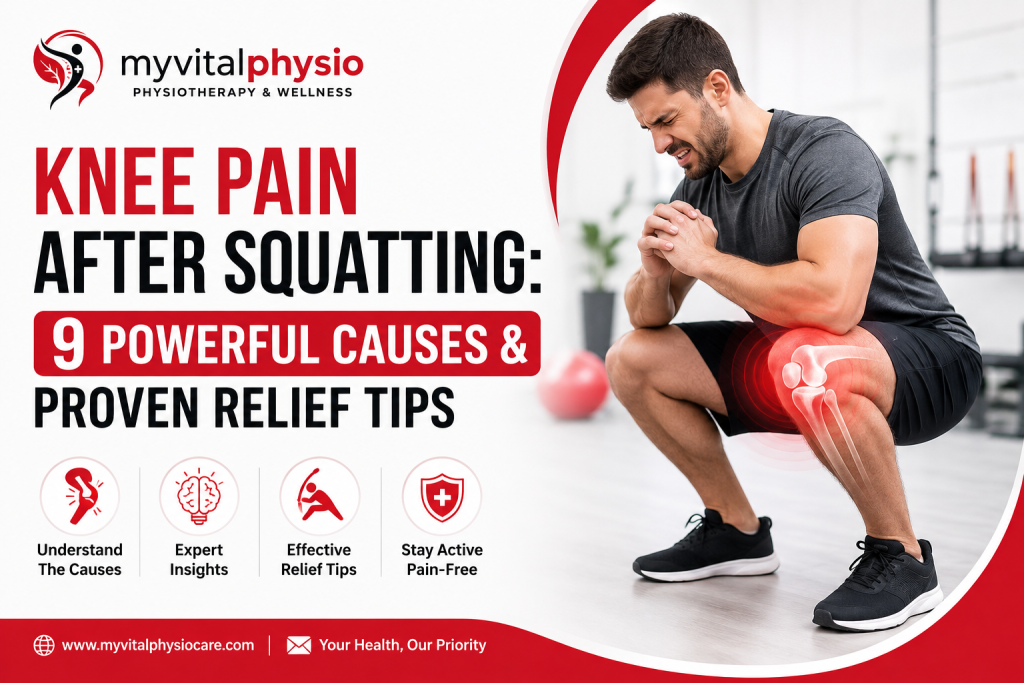
Knee Pain After Squatting: 9 Powerful Causes & Proven Relief Tips
Squats are one of the most useful movements for building strength in the legs and improving everyday mobility. However, if you regularly experience knee pain after squatting, the exercise can quickly become uncomfortable and frustrating. Pain may appear immediately after a squat, during the movement, or several minutes afterward.
Some people notice a mild ache around the kneecap, while others experience sharp pain, stiffness, swelling, clicking, or discomfort deep inside the knee. The symptoms can occur in people who exercise regularly as well as those who only squat occasionally.
Knee discomfort after squatting does not automatically mean that your knee is damaged. It can result from exercise technique, a sudden increase in activity, muscle weakness, limited mobility, overuse, or an underlying knee condition.
Understanding the possible causes can help you modify your activities and decide when professional assessment may be appropriate.
Medical disclaimer: This article is for general educational purposes and does not provide a diagnosis. If you have severe pain, significant swelling, instability, or an injury, consult a qualified healthcare professional.
What Does Knee Pain After Squatting Feel Like?
Knee discomfort can feel different depending on the underlying cause.
You may experience:
- Aching around the kneecap
- Sharp pain during or after a squat
- Pain underneath the kneecap
- Pain on the inside or outside of the knee
- Stiffness after exercising
- Swelling
- Clicking or grinding
- A feeling of weakness
- Difficulty climbing stairs
- Discomfort when standing up from a chair
Paying attention to exactly when the symptoms appear can provide useful information.
For example, pain that occurs mainly during deep squats may have a different cause from pain that appears several hours after exercise.
9 Common Causes of Knee Pain After Squatting
1. Poor Squatting Technique
One of the most common reasons for knee pain after squatting is performing the movement with a technique that places more stress on sensitive tissues.
Squatting involves coordinated movement of the ankles, knees, hips, and trunk. If your technique changes because of fatigue, weakness, limited mobility, or unfamiliarity with the exercise, the load may be distributed differently.
Common technique problems can include:
- Knees moving excessively inward
- Losing control during the downward phase
- Suddenly increasing squat depth
- Using more weight than you can comfortably control
- Moving too quickly
- Allowing the heels to lift
- Continuing despite increasing pain
Good technique does not mean that every person’s squat must look identical. Your ideal squat depth and stance depend on your anatomy, mobility, strength, and training goals.
If squatting consistently causes pain, reducing the load and getting your technique assessed can be helpful.
2. Patellofemoral Pain
Patellofemoral pain involves discomfort around or behind the kneecap. It is often associated with activities that repeatedly load the knee, including squatting, running, stairs, and jumping.
You may notice pain:
- Around the front of the knee
- Behind the kneecap
- During deep bending
- After prolonged sitting
- When walking downstairs
- During repeated squats
Muscle strength and movement control around the hip and knee may contribute to symptoms in some people.
A physiotherapist can evaluate your movement pattern and determine whether strengthening or modifying your activities could help.
3. Sudden Increase in Training
Your body needs time to adapt when you increase exercise intensity.
For example, suppose you normally perform two sets of bodyweight squats once or twice a week. Suddenly performing heavy squats five days a week can place a much greater demand on the knee and surrounding tissues.
A sudden increase in:
- Weight
- Repetitions
- Sets
- Training frequency
- Exercise intensity
- Squat depth
may contribute to soreness or irritation.
Instead of making dramatic changes, increase your training load gradually and allow enough recovery between demanding sessions.
4. Muscle Weakness
Strong muscles around the hips and legs help you control your movement during a squat.
The quadriceps, hamstrings, glutes, and calf muscles all contribute to lower-limb function.
If some muscles are weak or fatigue quickly, your movement may become less controlled as you squat.
Weakness does not necessarily mean that the knee itself is weak. It may mean that the muscles supporting and controlling the joint need more conditioning.
A progressive strengthening program can help improve strength and exercise tolerance.
5. Limited Ankle Mobility
Your ankle needs enough movement to allow you to perform a comfortable squat.
If ankle mobility is restricted, you may compensate by changing your knee, hip, or trunk position.
For example, limited ankle movement may make it difficult to keep your heels comfortably on the ground while descending.
The result may be an altered squat pattern that feels uncomfortable.
Working on ankle mobility may help some people, but the appropriate exercises depend on the reason for the restriction.
6. Tendon Irritation
The tendons around the knee can become irritated when they are exposed to repetitive or excessive loading.
Patellar tendon problems, for example, are commonly associated with activities involving jumping, running, and repeated loading of the knee.
Symptoms may include pain below the kneecap that becomes noticeable during or after exercise.
Tendon rehabilitation generally involves carefully managed loading rather than simply resting forever.
If tendon pain continues, a physiotherapist can help develop a gradual strengthening program.
7. Osteoarthritis
Osteoarthritis can affect the knee and may cause pain, stiffness, swelling, and reduced mobility.
Squatting can become uncomfortable because it requires substantial knee flexion and places load through the joint.
People with knee osteoarthritis may also experience symptoms during:
- Walking
- Stairs
- Getting up from a chair
- Standing for long periods
- Bending the knee
- Other weight-bearing activities
Not everyone with arthritis experiences the same symptoms.
Exercise and strengthening are commonly important parts of managing knee osteoarthritis, although an appropriate program should be tailored to the individual.
8. Meniscus Injury
The menisci are cartilage structures between the thighbone and shinbone. They help distribute load and contribute to knee stability.
A meniscus can be injured during twisting or pivoting, particularly when the foot is planted.
Possible symptoms include:
- Pain
- Swelling
- Clicking
- Catching
- Difficulty bending the knee
- Difficulty straightening the knee
- A locking sensation
If your symptoms began after a twisting injury or sports incident, medical assessment may be appropriate.
9. Previous Knee Injury
A previous injury can influence how your knee responds to squatting.
After an injury or surgery, you may have changes in:
- Strength
- Flexibility
- Balance
- Joint mobility
- Movement confidence
- Muscle coordination
These changes can make certain exercises uncomfortable even after normal walking has improved.
A structured rehabilitation program can help restore strength and movement gradually.
Why Does Squatting Cause Knee Pain?
Squatting requires the knee to bend while supporting body weight.
As you descend, the muscles around your knee and hip work to control the movement. The deeper you squat, the greater the demands can become on the tissues involved.
However, squat depth alone does not automatically cause injury.
A healthy person may be able to squat deeply without pain, while someone with an irritated knee may experience discomfort at a much shallower depth.
Your current strength, mobility, training history, recovery, technique, and any existing knee condition all matter.
How to Reduce Knee Pain After Squatting
If squats are causing discomfort, you do not necessarily have to stop all exercise.
Temporarily Reduce the Load
If you are using weights, reduce the resistance and see whether a lighter load is more comfortable.
You can also reduce the number of repetitions or sets.
Reduce Squat Depth
Deep squatting may be uncomfortable for an irritated knee.
Try a shallower squat and gradually increase your depth as your symptoms allow.
The goal is to find a comfortable level rather than forcing the deepest possible position.
Slow Down Your Movement
Controlled movement can help you maintain better awareness of your knee, hip, and ankle positions.
Avoid rushing through repetitions, particularly when you are learning a new technique.
Warm Up Before Exercise
A few minutes of gentle movement can prepare your body for exercise.
You might begin with:
- Easy walking
- Gentle cycling
- Controlled bodyweight movements
- Light mobility exercises
A warm-up should prepare you for activity rather than exhaust you.
Give Your Body Recovery Time
Training the same muscles intensely every day may not allow adequate recovery.
Include rest or lighter activity between demanding lower-body sessions.
Exercises That May Help
The best exercise program depends on the underlying cause of your symptoms. The following exercises can be useful for some people, but they should be performed comfortably and progressed gradually.
1. Glute Bridges
Lie on your back with your knees bent and feet flat on the floor.
Tighten your abdominal muscles gently and squeeze your glutes.
Lift your hips from the floor while keeping your knees aligned with your feet.
Pause briefly and lower slowly.
Perform several controlled repetitions.
2. Straight-Leg Raises
Lie on your back with one knee bent and the other leg straight.
Tighten the thigh muscle of the straight leg.
Slowly lift the leg, keeping your knee straight, and then lower it with control.
This exercise can help maintain quadriceps strength without requiring a deep squat.
3. Sit-to-Stand
Sit on a sturdy chair with your feet positioned comfortably on the floor.
Lean forward slightly and stand up using controlled movement.
Then slowly sit back down.
This exercise trains a functional movement similar to a shallow squat.
If pain increases significantly, reduce the range or stop.
4. Calf Raises
Stand near a wall or sturdy surface for balance.
Slowly rise onto your toes and then lower your heels.
Repeat in a controlled manner.
Strong calf muscles contribute to lower-limb function and can support everyday movement.
5. Mini Squats
Stand with your feet approximately hip-width apart.
Slowly bend your knees a small amount while keeping your movement controlled.
Return to standing.
A mini squat allows you to practice the movement without immediately entering a deep position.
As strength and tolerance improve, you can gradually increase the range.
When Should You Stop Squatting?
If squatting causes sharp or rapidly increasing pain, stop the exercise.
You should also stop and seek professional advice if you experience:
- Significant swelling
- A sudden popping sensation followed by pain
- Knee instability
- Locking
- Inability to bear weight
- Severe pain
- A major injury
Do not assume that pushing through severe pain will make the knee stronger.
Some mild muscle fatigue during exercise can be normal, but significant joint pain should not simply be ignored.
When Should You See a Physiotherapist?
Consider professional assessment if knee pain after squatting continues despite reducing your training load or modifying your technique.
A physiotherapist can assess:
- Knee mobility
- Hip strength
- Quadriceps strength
- Hamstring strength
- Ankle mobility
- Balance
- Squat technique
- Movement coordination
- Training habits
The assessment can help determine which factors may be contributing to your symptoms.
A rehabilitation program may include progressive strengthening, mobility exercises, movement retraining, and gradual return to normal activities.
When Is Knee Pain an Emergency?
Most exercise-related knee pain is not an emergency, but certain symptoms require prompt medical attention.
Seek urgent medical care if you:
- Cannot put weight on the leg
- Have severe swelling
- Have a visibly deformed knee
- Cannot move the knee normally
- Develop severe pain after a significant injury
- Have a hot, red knee accompanied by fever
Sudden swelling and pain in one leg may sometimes indicate a problem outside the knee joint, including a blood clot.
If you develop sudden leg swelling, warmth, or significant unexplained pain, seek urgent medical evaluation.
If leg symptoms occur together with chest pain or sudden difficulty breathing, seek emergency medical care.
How to Prevent Knee Pain During Squats
Prevention does not mean avoiding every movement that could potentially cause discomfort. Instead, focus on gradually building your capacity.
Progress Gradually
Increase weights and repetitions slowly.
Avoid doubling your training volume from one week to the next.
Improve Your Strength
Train the muscles around your hips and legs consistently.
Include exercises for:
- Quadriceps
- Hamstrings
- Glutes
- Calves
- Hip muscles
Pay Attention to Recovery
Sleep, rest days, nutrition, and appropriate training volume all influence your ability to recover.
Use Comfortable Footwear
Appropriate footwear can make exercise more comfortable and provide a stable base.
The ideal shoe depends on the activity and the individual’s needs.
Do Not Ignore Persistent Symptoms
Occasional muscle soreness after a new workout can happen.
However, recurring joint pain every time you squat deserves attention.
Identifying the problem early may make it easier to modify your exercise routine and avoid repeatedly aggravating the same tissues.
Frequently Asked Questions
Is knee pain after squatting normal?
Mild muscle soreness after starting a new exercise program can be normal, but persistent or significant knee pain should not simply be considered normal. Repeated pain may indicate that your training load, technique, mobility, or another factor needs attention.
Should I stop squatting if my knees hurt?
If squatting causes significant pain, temporarily stop or modify the movement. You may be able to use a shallower range, lighter resistance, or another exercise while the symptoms settle.
Can weak muscles cause knee pain?
Muscle weakness can affect how the lower limb is controlled during movement and may contribute to symptoms in some people. Strengthening the hips and legs can be an important part of rehabilitation.
Can squats damage your knees?
Squats are not inherently harmful to healthy knees. They are a normal movement pattern and can be part of a strength program. Problems may occur when training load, technique, recovery, or an underlying condition is not appropriately managed.
Should I use ice after squatting?
If your knee feels irritated or mildly swollen after exercise, a wrapped cold pack may provide temporary symptom relief. Do not place ice directly against your skin.
Can physiotherapy help knee pain?
Physiotherapy can help identify movement, strength, mobility, and training factors that may contribute to knee symptoms. A physiotherapist can then develop a personalized rehabilitation plan.
Final Thoughts
Knee pain after squatting can have many possible causes, from exercise technique and sudden increases in training to tendon irritation, patellofemoral pain, arthritis, meniscus problems, and previous injuries.
The important point is that pain does not automatically mean you must permanently avoid squats.
Start by looking at your training volume, squat depth, resistance, technique, recovery, and overall strength. Temporarily modifying the exercise may allow you to stay active while reducing irritation.
Gentle strengthening exercises such as glute bridges, straight-leg raises, sit-to-stands, calf raises, and mini squats may be useful for some people when performed appropriately.
However, persistent or worsening symptoms should be assessed by a qualified healthcare professional. Severe swelling, inability to bear weight, significant injury, locking, instability, or other concerning symptoms require prompt evaluation.
With the right assessment and a gradual rehabilitation approach, many people can improve their knee function and return to the activities they enjoy.