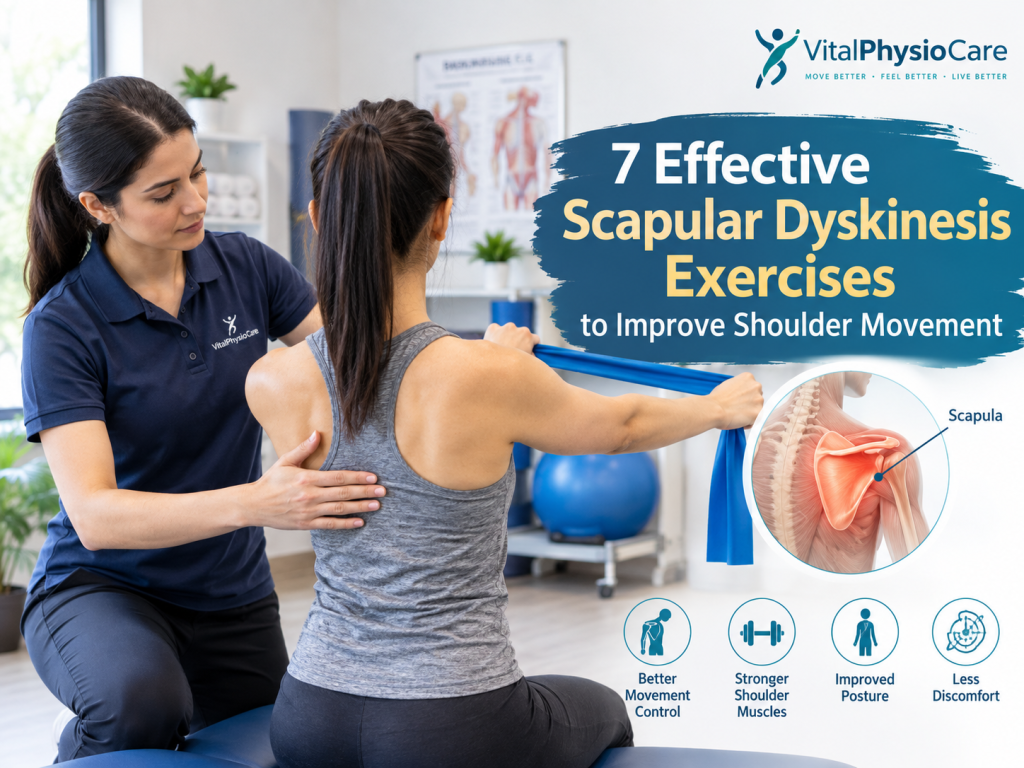
7 Effective Scapular Dyskinesis Exercises for Better Movement
Shoulder movement depends on more than the shoulder joint itself. The shoulder blade, also known as the scapula, works together with the surrounding muscles, collarbone, and upper arm to help you lift, rotate, push, and reach comfortably. When the shoulder blade moves or rests differently than expected, it is called scapular dyskinesis. This movement problem may occur alongside shoulder pain, weakness, or difficulty performing everyday activities.
Scapular dyskinesis exercises can help improve shoulder-blade control, strengthen supporting muscles, and restore comfortable movement when muscle weakness or movement-control problems contribute to the condition. However, the right exercise program depends on the underlying cause, your symptoms, and your current shoulder function.
In this guide, we explain what scapular dyskinesis means, seven exercises that may support rehabilitation, common mistakes to avoid, and when to seek professional help.
What Is Scapular Dyskinesis?
Scapular dyskinesis describes an alteration in the normal resting position or movement of the shoulder blade. During healthy shoulder movement, the scapula rotates and glides across the rib cage to help position the arm.
If this coordination changes, the inner edge of the shoulder blade may become more prominent, or the shoulder may move differently when you raise your arm. Some people experience shoulder discomfort, reduced strength, fatigue, or difficulty reaching overhead. Others may have visible movement changes without significant pain.
According to the American Academy of Orthopaedic Surgeons (AAOS), treatment commonly focuses on strengthening the muscles that stabilize and move the shoulder blade and stretching muscles that restrict normal movement.
Source: https://orthoinfo.aaos.org/diseases–conditions/scapular-shoulder-blade-disorders/
It is important to understand that scapular dyskinesis is a movement impairment rather than one single disease. It can occur with other shoulder conditions, so a healthcare professional may need to assess the shoulder before recommending specific exercises.
Common Signs and Possible Causes
Symptoms vary from person to person. Possible signs include:
- Shoulder discomfort during lifting or reaching.
- A shoulder blade that appears to stick out more than usual.
- Fatigue during repetitive arm movements.
- Reduced control when raising or lowering the arm.
- Discomfort during sports or overhead activities.
- Associated neck or upper-back tension.
Possible contributing factors include muscle weakness, reduced flexibility, repetitive overhead activity, poor movement coordination, previous shoulder injuries, and certain nerve-related problems.
Posture may contribute to some movement difficulties, but scapular dyskinesis should not automatically be blamed on poor posture. A professional assessment can help identify the factors that matter in an individual case.
7 Effective Scapular Dyskinesis Exercises
The following scapular dyskinesis exercises are examples of movements commonly used in shoulder rehabilitation. They are not a personalized treatment plan, and not every exercise is appropriate for every person.
Begin gently, use a comfortable range of motion, and stop if an exercise causes sharp pain, increasing weakness, numbness, or other unusual symptoms. If you have had shoulder surgery, a recent injury, or a suspected nerve problem, consult your healthcare professional before beginning.
1. Gentle Scapular Retraction
Scapular retraction helps you practise controlled movement of the shoulder blades and activate muscles around the upper back.
How to perform it:
- Sit or stand upright with your arms relaxed by your sides.
- Keep your neck relaxed and look straight ahead.
- Gently draw your shoulder blades slightly toward each other.
- Avoid lifting your shoulders toward your ears or arching your lower back.
- Hold the position for approximately three to five seconds.
- Relax completely before repeating.
Suggested starting point: Try 8–10 comfortable repetitions, provided the movement does not increase your symptoms.
Why it may help: This exercise encourages awareness and control of the muscles that move the shoulder blades. It is often a useful starting point before progressing to resistance exercises.
Common mistake: Squeezing the shoulder blades as hard as possible. The goal is controlled movement, not maximum force.
2. Wall Push-Ups
Wall push-ups provide a supported way to practise upper-body movement without immediately placing the same load on the shoulders as a floor push-up.
How to perform it:
- Stand facing a wall, approximately an arm’s length away.
- Place your palms against the wall around shoulder height.
- Keep your body in a comfortable straight line.
- Slowly bend your elbows and move your chest toward the wall.
- Push gently away from the wall until your arms straighten.
- Maintain relaxed shoulders and controlled shoulder-blade movement.
Suggested starting point: Perform 6–10 repetitions if comfortable.
Why it may help: Wall push-ups train the muscles involved in pushing and shoulder-blade stabilization. The wall allows you to adjust the resistance by changing your body position.
Common mistake: Allowing the shoulders to shrug upward or forcing the movement through pain. Move closer to the wall if the exercise feels too difficult.
3. Serratus Anterior Wall Slides
The serratus anterior muscle helps the shoulder blade move smoothly around the rib cage and contributes to upward rotation during arm elevation.
How to perform it:
- Stand facing a wall.
- Place your forearms against the wall, with your elbows comfortably bent.
- Apply light pressure through your forearms.
- Slowly slide your arms upward within a comfortable range.
- Keep your neck relaxed and avoid shrugging excessively.
- Return slowly to the starting position.
Suggested starting point: Try 6–8 slow repetitions.
Why it may help: Wall slides can develop coordination between the arm and shoulder blade while practising a movement used in reaching overhead.
Common mistake: Sliding the arms too high before you can control the movement. Stop at a comfortable height and increase the range gradually.
4. Resistance Band Rows
Resistance band rows strengthen muscles around the shoulder blades and upper back. They may be introduced when basic shoulder movements are comfortable.
How to perform it:
- Secure a resistance band to a stable anchor at approximately chest height.
- Hold one end in each hand with your arms extended comfortably.
- Stand or sit upright and keep your elbows close to your body.
- Pull your elbows backward while drawing your shoulder blades gently toward each other.
- Pause briefly without shrugging.
- Slowly return to the starting position.
Suggested starting point: Complete 1–2 sets of 8–10 repetitions using light resistance.
Why it may help: Rows strengthen muscles involved in controlling the shoulder blades during pulling movements. They can also complement other upper-body exercises.
Common mistake: Leaning backward, using momentum, or pulling the elbows too far behind the body. Reduce the resistance if you cannot maintain good control.
5. Supine Serratus Punches
This exercise is performed lying on your back and focuses on controlled forward movement of the shoulder blade.
How to perform it:
- Lie on your back with your knees bent and your arm pointing toward the ceiling.
- Keep your elbow straight but not forcefully locked.
- Gently reach your hand upward so your shoulder blade lifts slightly from the floor.
- Avoid lifting your head or twisting your trunk.
- Lower the shoulder blade slowly to its starting position.
Suggested starting point: Try 8–10 repetitions without a weight.
Why it may help: The movement targets the serratus anterior and encourages the shoulder blade to move independently of the trunk.
Common mistake: Bending the elbow or lifting the entire shoulder and head. Keep the movement small and controlled.
If this exercise causes shoulder pain, stop and ask a physiotherapist whether a different variation is appropriate.
6. Gentle Chest Stretch
Tightness in the chest muscles may contribute to restricted shoulder movement in some people. A gentle stretch can be useful when an assessment indicates that increased flexibility is needed.
How to perform it:
- Stand beside a doorway.
- Place your forearm against the doorframe with your elbow below shoulder height.
- Step forward slightly until you feel a mild stretch across the front of your chest.
- Keep your neck relaxed and avoid arching your lower back.
- Hold for 15–20 seconds while breathing normally.
- Release slowly and repeat on the other side if needed.
Suggested starting point: Perform 2 gentle holds on each side.
Why it may help: Improving flexibility in restricted chest muscles may make it easier for some people to position their shoulders comfortably.
Common mistake: Pushing into a painful stretch or positioning the arm too high. Reduce the stretch immediately if you feel pinching inside the shoulder joint.
7. Prone Shoulder-Blade Lifts
Prone shoulder-blade lifts can strengthen muscles around the upper back and may be suitable for people who can already tolerate basic exercises.
How to perform it:
- Lie face down on a firm, comfortable surface.
- Keep your forehead supported on a folded towel.
- Rest your arms beside your body.
- Gently draw your shoulder blades toward each other.
- If comfortable, lift your hands a small distance from the surface.
- Lower your arms slowly and relax between repetitions.
Suggested starting point: Try 6–8 repetitions without weights.
Why it may help: This movement can train the muscles that contribute to shoulder-blade control and upper-back strength.
Common mistake: Lifting the head, arching the lower back, or raising the arms too high. Keep the movement small and focus on the shoulder blades.
This exercise may not be suitable for people with significant shoulder pain or certain injuries. A physiotherapist can recommend an appropriate alternative.
How to Start a Safe Exercise Routine
A gradual approach is generally more useful than trying to complete all seven exercises at full intensity on the first day.
For beginners, a physiotherapist may select two or three suitable movements and adjust the repetitions according to your symptoms and physical examination. Start with little or no resistance, move slowly, and allow enough recovery between sessions.
Use these general principles:
- Start comfortably: Choose movements you can perform without sharp pain.
- Focus on technique: Controlled repetitions are more useful than rushing.
- Progress gradually: Increase repetitions or resistance only when the current level feels manageable.
- Balance your program: Shoulder rehabilitation may involve mobility, strengthening, and movement-control exercises rather than one isolated muscle group.
- Monitor symptoms: Your shoulder should not become progressively more painful after exercise.
There is no single repetition schedule that suits everyone with scapular dyskinesis. A program designed for an athlete who performs overhead movements may differ significantly from one designed for someone who has difficulty with everyday reaching.
The Cambridge University Hospitals NHS Foundation Trust provides additional guidance on scapular stabilization exercises:
Common Mistakes to Avoid
Even simple scapular dyskinesis exercises can become uncomfortable when performed incorrectly or progressed too quickly.
Using too much resistance: Heavy bands or weights may encourage compensatory movements. Begin with a manageable load.
Shrugging the shoulders: Excessive elevation can make it harder to practise the intended movement. Keep your neck relaxed.
Forcing a painful range: Do not push through sharp pain, pinching, or a sudden loss of movement.
Ignoring the underlying cause: Muscle strengthening alone may not address a fracture, significant tendon injury, joint instability, or nerve problem.
Expecting immediate results: Strength, coordination, and movement tolerance usually require consistent practice. The time needed for improvement depends on the cause and severity of the problem.
Copying an exercise program without assessment: An exercise that helps one person may aggravate symptoms in another. Individual guidance is particularly important when symptoms are persistent or severe.
When Should You See a Physiotherapist or Doctor?
Arrange a professional assessment if your shoulder blade visibly protrudes, your arm feels unusually weak, you have persistent shoulder pain, or you struggle to lift your arm during normal activities.
Seek urgent medical attention after a serious injury, for a visibly deformed shoulder, sudden major weakness, or a hot, red shoulder accompanied by fever. Sudden shoulder or arm discomfort accompanied by chest pressure, breathlessness, sweating, or pain spreading to the jaw requires emergency assessment.
A clinician may examine shoulder movement, strength, flexibility, neck function, and possible nerve involvement. Further investigations may be recommended when the findings suggest an underlying injury or another medical condition.
If symptoms do not improve or worsen despite modifying your activities, seek professional advice rather than continually adding more exercises.
Frequently Asked Questions
1. Can scapular dyskinesis improve with exercise?
In some cases, yes. Exercises that address relevant weakness, restricted flexibility, and movement-control problems can form an important part of rehabilitation. Results depend on the underlying cause and whether another shoulder condition is present.
2. How often should I perform scapular dyskinesis exercises?
The appropriate frequency depends on your symptoms, exercise selection, and rehabilitation goals. A clinician may recommend practising selected movements several times per week or more frequently for certain low-load exercises. Follow your individualized instructions rather than treating one schedule as universal.
3. Are scapular dyskinesis exercises safe to perform at home?
Some gentle exercises may be appropriate at home, but safety depends on the cause of the movement problem. If you have recently been injured, undergone surgery, or developed marked weakness, obtain professional guidance before starting.
4. Do these exercises permanently correct shoulder-blade movement?
Not necessarily. Exercises can improve strength, coordination, and function, but outcomes vary. Persistent movement changes caused by nerve damage or structural injury may require additional assessment and treatment.
5. Can poor posture cause scapular dyskinesis?
Posture and habitual movement patterns may influence shoulder mechanics, but they are not the only causes. Muscle weakness, restricted mobility, injury, and neurological factors can also contribute.
Conclusion
Scapular dyskinesis can affect how the shoulder blade moves during reaching, lifting, pushing, and other everyday activities. The right rehabilitation approach focuses on the factors contributing to the movement problem rather than treating every person in the same way.
These seven scapular dyskinesis exercises introduce several common rehabilitation movements, including scapular retraction, wall push-ups, wall slides, band rows, serratus punches, chest stretching, and prone shoulder-blade lifts. Start gently, prioritize good technique, and progress only when your symptoms allow.
Most importantly, do not assume that every visible shoulder-blade movement change is caused by muscle weakness. If you experience persistent pain, noticeable weakness, or difficulty moving your arm, consult a qualified healthcare professional for an appropriate assessment and treatment plan.