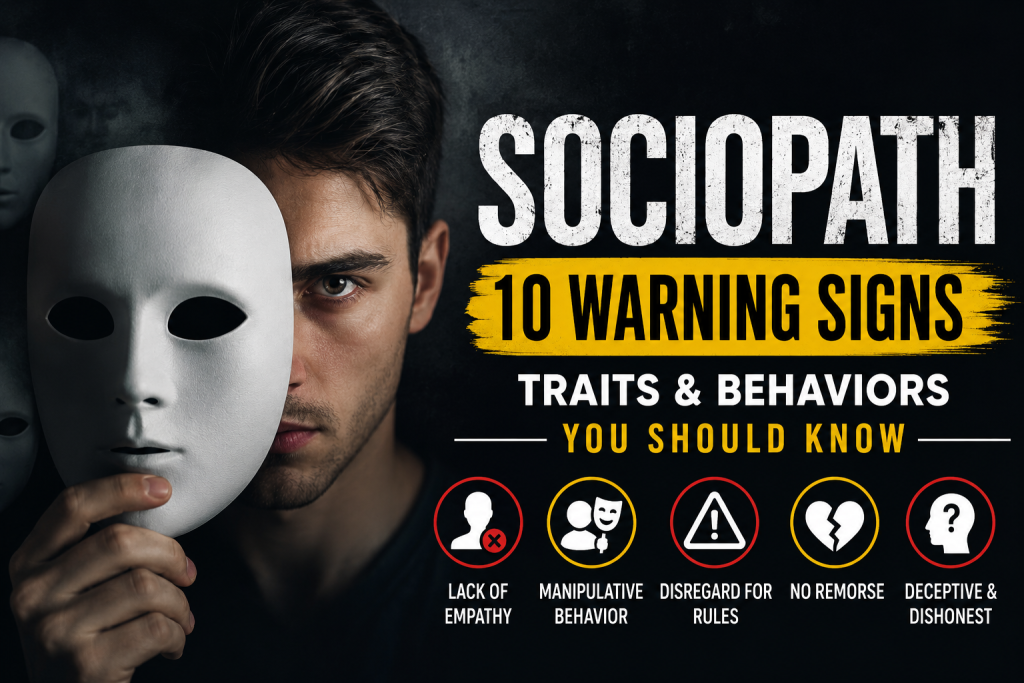
Sociopath: 10 Warning Signs, Traits & Behaviors You Should Know
When people hear the word sociopath, they often imagine someone who is manipulative, dishonest, aggressive, or unable to care about other people’s feelings. The term is widely used in everyday conversations, movies, and online discussions, but it is important to understand what it actually means.
Sociopath is not an official medical diagnosis. Mental-health professionals generally use the diagnosis antisocial personality disorder (ASPD) when a person shows a persistent pattern of disregarding and violating the rights of others. The word sociopath is commonly used to describe certain antisocial personality traits, but it should not be used casually to label someone based on a few unpleasant behaviors.
Understanding the difference can help people recognize unhealthy patterns without jumping to conclusions. A person who lies occasionally, becomes angry, or behaves selfishly is not automatically a sociopath. Personality disorders involve long-term patterns that affect relationships, behavior, decision-making, and functioning.
This guide explains 10 commonly discussed signs and behaviors associated with sociopathic traits, what may contribute to them, how they can affect relationships, and when professional support may be appropriate.
What Does Sociopath Mean?
The word sociopath is commonly used to describe a person who demonstrates persistent antisocial behaviors and has difficulty respecting social rules, boundaries, or the rights of others.
In clinical settings, professionals may instead evaluate whether someone meets criteria for antisocial personality disorder. Diagnosis requires a comprehensive assessment by a qualified mental-health professional.
A person should not be considered a sociopath simply because they are confident, emotionally reserved, independent, introverted, or occasionally selfish. Human behavior exists on a spectrum, and many behaviors that seem concerning can have different explanations.
10 Warning Signs and Traits Associated With a Sociopath
The following behaviors may be associated with antisocial personality traits. Having one or even several of these characteristics does not automatically mean someone has a personality disorder.
1. Frequent Lying and Deception
One commonly discussed characteristic of a sociopath is repeated dishonesty. This can include lying about personal information, finances, relationships, achievements, or other situations.
The purpose of deception may vary. Some people lie to obtain something they want, avoid responsibility, manipulate another person, or create a particular impression.
Occasional lying is common among humans. What can be more concerning is a persistent pattern of deception that causes significant harm to other people.
2. Manipulative Behavior
Manipulation involves attempting to control another person’s decisions, emotions, or behavior through unfair or deceptive methods.
A person with strong antisocial traits may use guilt, intimidation, dishonesty, charm, pressure, or emotional tactics to get what they want.
For example, someone might repeatedly make another person feel responsible for problems they did not cause. They may also change their story when confronted or attempt to turn people against each other.
Healthy relationships allow both people to express boundaries and make independent choices. Persistent manipulation can undermine trust and emotional well-being.
3. Lack of Remorse
Another behavior associated with a sociopath is limited remorse after hurting or exploiting others.
A person may recognize that something went wrong but show little concern about how their actions affected another individual. They may blame the victim, minimize the behavior, or simply move on without taking responsibility.
However, emotional responses differ between individuals. Lack of visible emotion does not always mean someone has no conscience or empathy. A professional assessment is needed before drawing conclusions about a person’s personality.
4. Disregard for Rules and Social Norms
Repeatedly ignoring important rules can be another feature associated with antisocial behavior.
This may include consistently violating laws, workplace policies, agreements, or social expectations. The issue is not simply breaking a minor rule once. Instead, professionals look at broader patterns of behavior over time.
Persistent disregard for rules can create problems at work, in relationships, financially, and legally.
5. Impulsive Decisions
Impulsivity can also occur in people with antisocial personality traits.
A person may make decisions without considering the consequences for themselves or others. This could involve reckless spending, unsafe behavior, sudden relationship decisions, or other actions that create unnecessary risks.
Impulsivity can have many causes, including stress, substance use, other mental-health conditions, and personality characteristics. Therefore, it should never be used alone to identify a sociopath.
6. Aggressive or Irritable Behavior
Some people with antisocial personality traits may demonstrate irritability, hostility, or aggressive behavior.
This could involve frequent arguments, threats, intimidation, physical aggression, or a tendency to respond disproportionately to frustration.
Not everyone with antisocial traits is violent, and not every aggressive person has a personality disorder. Aggression has many possible causes, and professional evaluation is important when behavior becomes persistent or dangerous.
If someone is threatening you or making you feel physically unsafe, prioritize your safety rather than trying to determine whether that person is a sociopath.
7. Repeatedly Exploiting Other People
A pattern of taking advantage of others may be another warning sign.
This can happen financially, emotionally, socially, or professionally. Someone may repeatedly use another person’s generosity without reciprocating or may exploit someone’s trust for personal benefit.
Healthy relationships generally involve mutual respect, communication, and reasonable boundaries. Repeated exploitation can be a serious relationship red flag regardless of whether a person has a mental-health diagnosis.
8. Difficulty Maintaining Healthy Relationships
People with significant antisocial traits may experience repeated relationship problems.
Their relationships can involve deception, conflict, broken promises, manipulation, betrayal, or disregard for another person’s needs.
A pattern is more meaningful than a single failed relationship. Everyone experiences disagreements and breakups. What matters is whether similar harmful behaviors repeatedly appear across different relationships.
9. Blaming Others for Problems
Another commonly discussed behavior is refusing to accept responsibility.
Instead of acknowledging mistakes, a person may consistently blame partners, coworkers, family members, or circumstances.
For example, they may say that someone else forced them to behave badly or that their actions were entirely justified because another person supposedly caused the situation.
Taking responsibility is an important part of healthy emotional development. Persistent externalization of blame can make conflict extremely difficult to resolve.
10. Superficial Charm
Some people with antisocial traits may appear confident, charismatic, persuasive, or charming when meeting others.
Charm itself is obviously not a negative characteristic. Many kind and emotionally healthy people are charismatic.
The concern arises when charm is repeatedly combined with deception, manipulation, exploitation, or disregard for other people’s rights.
A friendly personality should never be treated as evidence that someone is a sociopath.
Sociopath vs. Psychopath: Are They the Same?
The terms sociopath and psychopath are often used interchangeably in popular culture, but they are not straightforward clinical diagnoses.
Both terms have historically been associated with antisocial behavior, but mental-health professionals generally focus on recognized diagnostic criteria, particularly antisocial personality disorder.
Popular descriptions often portray psychopathy as involving more calculated and emotionally detached behavior, while sociopathy is sometimes described as being more reactive or influenced by environmental factors. However, these distinctions are not official diagnostic categories in the way people commonly assume.
For this reason, it is better to focus on specific behaviors and professional diagnostic criteria rather than labels.
What Causes Sociopathic Traits?
There is no single cause of antisocial personality traits.
Research suggests that personality and behavior can be influenced by a combination of biological, psychological, developmental, and environmental factors.
Possible influences may include genetics, early developmental experiences, family environment, childhood adversity, social circumstances, and other psychological factors.
Importantly, experiencing childhood trauma or growing up in a difficult environment does not mean someone will develop antisocial personality disorder. Most people who experience adversity do not become abusive or antisocial.
Personality development is complex, and professionals consider a person’s overall history rather than one particular event.
Is Sociopathy a Mental Illness?
The word sociopath itself is not a formal psychiatric diagnosis.
Antisocial personality disorder, however, is a recognized mental-health condition. Diagnosis involves evaluating a longstanding pattern of behavior and considering developmental history and other possible explanations.
A qualified professional may assess areas such as relationships, behavior, emotional functioning, history of rule-breaking, impulsivity, aggression, and responsibility.
It is important not to diagnose a partner, family member, coworker, or friend based on online checklists.
Can a Sociopath Love Someone?
This is one of the most common questions people ask about a sociopath.
Human emotions and relationships are complicated. A person with antisocial traits may experience attachment, attraction, affection, or other emotions. However, difficulties with empathy, responsibility, trust, or interpersonal behavior can make relationships challenging.
Rather than focusing only on whether someone loves you, consider how they treat you.
Respect, honesty, safety, accountability, and consistent behavior are more useful indicators of a healthy relationship than someone’s promises or declarations of love.
How a Sociopath May Affect Relationships
A relationship involving persistent manipulation or antisocial behavior can become emotionally exhausting.
A partner may feel confused because the person’s behavior changes depending on the situation. They might apologize after an argument and then repeat the same behavior later.
Other possible relationship problems include:
- Frequent dishonesty
- Broken promises
- Emotional manipulation
- Financial exploitation
- Repeated betrayal
- Intimidation
- Boundary violations
- Refusal to accept responsibility
- Constant conflict
- Lack of emotional support
These behaviors are concerning regardless of whether the person has a specific diagnosis.
What Should You Do If You Think Someone Is a Sociopath?
If you believe someone in your life displays serious antisocial or manipulative behavior, avoid trying to diagnose them yourself.
Instead, focus on the behavior and its effect on you.
Set clear boundaries about what you will and will not accept. Keep important financial and personal information secure. Maintain supportive connections with trusted people, especially if you feel isolated.
If the relationship involves threats, violence, stalking, coercion, or other dangerous behavior, seek help from appropriate local services or a trusted professional.
You do not need a psychiatric label to justify protecting yourself from harmful behavior.
When Should Someone Seek Professional Help?
Professional support may be appropriate when a person’s behavior repeatedly causes serious problems in relationships, work, family life, or personal functioning.
A mental-health professional can evaluate symptoms, developmental history, behavior patterns, and other possible conditions.
Therapy and other forms of mental-health treatment may help some people develop healthier coping strategies, improve decision-making, understand consequences, and manage problematic behaviors.
Treatment approaches depend on the individual’s needs and clinical situation.
Frequently Asked Questions
What is a sociopath?
A sociopath is a commonly used, non-clinical term for someone perceived to have persistent antisocial personality traits. Mental-health professionals generally use recognized diagnoses such as antisocial personality disorder instead.
What are the biggest warning signs of a sociopath?
Commonly discussed signs include repeated deception, manipulation, lack of remorse, disregard for rules, impulsivity, aggression, exploitation, relationship difficulties, blaming others, and superficial charm. These behaviors do not independently establish a diagnosis.
Can a sociopath change?
Behavior can change, although personality-related patterns may be difficult to modify. Professional mental-health support may help some individuals develop healthier behaviors and improve functioning.
Is every manipulative person a sociopath?
No. Manipulation can occur for many different reasons and does not automatically indicate antisocial personality disorder.
Can a sociopath have friends and relationships?
Yes. People with antisocial traits can form social connections and relationships. However, persistent problems with trust, responsibility, empathy, or exploitation may make relationships difficult.
Can a sociopath be dangerous?
Some individuals with antisocial traits may engage in aggressive or harmful behavior, but it is incorrect to assume that everyone described as a sociopath is violent or dangerous. Risk depends on the individual and their behavior.
Final Thoughts
The word sociopath is widely used, but it can oversimplify complicated human behavior. Rather than labeling someone based on a few characteristics, it is better to look at persistent patterns of deception, manipulation, exploitation, aggression, disregard for others, and lack of accountability.
If someone’s behavior repeatedly makes you feel unsafe, controlled, threatened, or emotionally harmed, you do not need to determine whether they are a sociopath before taking appropriate action.
When serious personality or behavioral concerns exist, a qualified mental-health professional can provide a proper evaluation. For anyone experiencing abuse or immediate danger, personal safety should always come first.