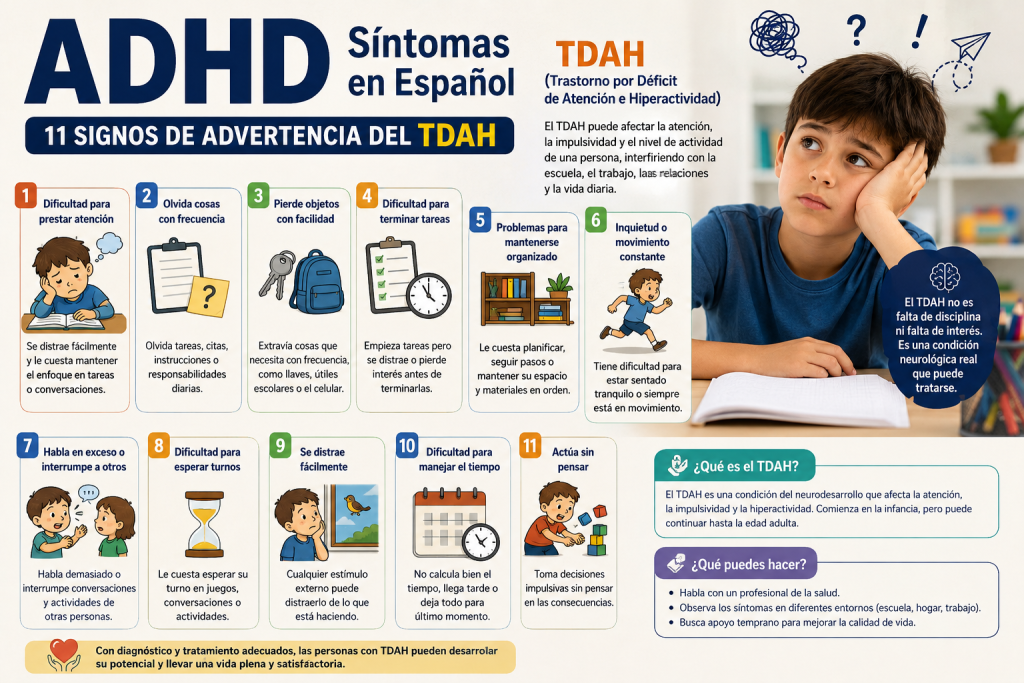
ADHD Symptoms in Spanish: 11 Warning Signs, TDAH Meaning & What to Know
Understanding ADHD symptoms in Spanish can help Spanish-speaking families recognize possible signs of attention-deficit/hyperactivity disorder and know when professional guidance may be appropriate. In Spanish, ADHD is commonly called TDAH, which stands for trastorno por déficit de atención e hiperactividad.
TDAH is a neurodevelopmental condition that can affect attention, organization, activity level, impulse control, and everyday functioning. Although it is often identified during childhood, symptoms can continue into adolescence and adulthood. The way symptoms appear may also change as a person gets older.
It is important to remember that having difficulty concentrating, feeling restless, or occasionally forgetting things does not automatically mean a person has ADHD. Many other factors, including sleep problems, stress, anxiety, depression, and learning difficulties, can produce similar behaviors. A qualified healthcare professional is needed for an appropriate evaluation.
What Does ADHD Mean in Spanish?
ADHD is known in Spanish as TDAH, or trastorno por déficit de atención e hiperactividad.
The condition generally involves persistent difficulties related to attention, hyperactivity, and impulsivity. These difficulties can interfere with school, work, relationships, family responsibilities, or other areas of everyday life.
There are three recognized presentations of TDAH:
- Predominantly inattentive presentation
- Predominantly hyperactive-impulsive presentation
- Combined presentation
A person may have symptoms from one group or a combination of both major symptom areas. Symptoms can also change over time.
1. Difficulty Paying Attention
One of the most recognizable ADHD symptoms in Spanish is difficulty maintaining attention.
A person may struggle to remain focused during conversations, school lessons, meetings, reading, or tasks that require sustained mental effort.
For example, someone may start reading a page but realize several minutes later that they cannot remember what they read. A child may appear to be listening but become distracted by sounds, objects, or activities around them.
Everyone loses focus occasionally. The difference is that ADHD-related attention difficulties tend to be persistent and can interfere with normal functioning.
2. Frequently Forgetting Important Things
Forgetfulness can be another common feature of TDAH.
A child might forget homework, school materials, instructions, or daily responsibilities. Adults may frequently forget appointments, bills, keys, work tasks, or other important items.
This does not necessarily mean the person lacks effort or motivation. Difficulties with attention, working memory, organization, and managing multiple tasks can contribute to forgetfulness.
If forgetfulness happens regularly and creates significant problems at school, work, or home, discussing the pattern with a healthcare professional may be useful.
3. Losing Personal Items Often
People experiencing ADHD-related attention difficulties may frequently misplace things they need.
Common examples include:
- Keys
- Phones
- Wallets
- Glasses
- School supplies
- Documents
- Work materials
- Remote controls
Occasionally losing something is normal. However, repeatedly losing essential items can become frustrating and interfere with everyday responsibilities.
Creating consistent storage locations, using reminders, and organizing frequently used items can help reduce the practical impact of this problem.
4. Trouble Finishing Tasks
Starting a task may be easier than completing it.
A person with possible TDAH may begin cleaning a room, writing an assignment, preparing a report, or completing household responsibilities but become distracted before finishing.
Long tasks that require sustained concentration can be especially challenging.
This can sometimes be mistaken for laziness. However, difficulty completing tasks may involve attention regulation, planning, time management, or distractibility rather than a lack of willingness.
Breaking large activities into smaller steps may make them easier to manage.
5. Difficulty Staying Organized
Organization can be challenging for people experiencing ADHD symptoms.
A student may struggle to keep track of assignments and deadlines. An adult may have difficulty managing appointments, paperwork, household responsibilities, or workplace priorities.
Someone may know what needs to be done but have trouble deciding where to begin.
Organizational strategies can include written schedules, digital reminders, calendars, checklists, labeled storage areas, and breaking large projects into smaller goals.
If organizational difficulties are persistent and affect several areas of life, professional evaluation can help determine whether TDAH or another condition may be contributing.
6. Restlessness or Constant Movement
Hyperactivity is another major area when discussing ADHD symptoms in Spanish.
Children with hyperactive symptoms may have difficulty sitting quietly for extended periods. They may move around frequently, fidget, climb, run, or appear constantly active.
Adults may experience hyperactivity differently. Instead of obvious running or climbing, they may describe an internal feeling of restlessness or a strong need to keep moving.
CDC information explains that ADHD symptoms can appear differently depending on age, and hyperactivity in adults may become more like pronounced restlessness.
Being energetic does not automatically indicate ADHD. The pattern, persistence, and effect on everyday life are important considerations.
7. Talking Excessively or Interrupting Others
Impulsivity can affect conversations and social interactions.
A person may frequently interrupt, answer questions before they are completed, speak without considering how the words may affect others, or have difficulty waiting for a natural opportunity to talk.
Children may interrupt teachers or classmates, while adults may interrupt coworkers, friends, or family members.
These behaviors can sometimes create misunderstandings in relationships.
Occasional interruptions are normal, particularly during exciting conversations. However, persistent impulsive communication that causes difficulties in multiple settings may be worth discussing with a healthcare provider.
8. Difficulty Waiting for a Turn
Another possible sign is difficulty waiting.
A child may struggle to wait during games, classroom activities, or conversations. An adult may become unusually impatient while waiting in lines, meetings, or group discussions.
Impulsivity can make it difficult to pause and wait for the appropriate moment to act or speak.
This does not mean that every impatient person has TDAH. Symptoms need to be considered as part of a larger pattern.
9. Easily Distracted
Distractibility is an important part of the inattentive symptom group.
A person may be pulled away from a task by background conversations, phone notifications, movement in the room, thoughts, or unrelated activities.
For students, this can make studying difficult. At work, frequent distractions can interfere with productivity. At home, someone may begin one household activity and unexpectedly switch to several others.
Reducing unnecessary distractions, using short work periods, and keeping a written task list may help improve concentration.
10. Difficulty Managing Time
Time management can be challenging for some people with ADHD.
A person may underestimate how long a task will take, forget deadlines, arrive late, or postpone an important responsibility until the last moment.
This may lead to a cycle of stress and rushed work.
For children, difficulties with time management may affect homework and school preparation. Adults may experience problems with work deadlines, appointments, household responsibilities, or personal projects.
Using alarms, calendar reminders, visual schedules, and realistic time estimates can provide useful support.
11. Acting Without Thinking
Impulsive behavior is another important part of TDAH.
Someone may make quick decisions without considering possible consequences, interrupt conversations, spend money impulsively, or respond emotionally before having time to think.
In children, impulsivity can sometimes appear as grabbing objects, interrupting others, or having difficulty following turn-taking rules.
Adults may experience impulsivity through rapid decisions, difficulty delaying gratification, or challenges controlling immediate reactions.
Impulsivity can have many causes, so it should not be interpreted as proof of ADHD by itself.
ADHD Symptoms in Children
When looking at ADHD symptoms in Spanish, parents often want to know how TDAH can appear in children.
Possible signs include frequent daydreaming, forgetfulness, losing school supplies, difficulty following instructions, excessive movement, frequent talking, interrupting, difficulty waiting, and trouble completing schoolwork.
According to the CDC, ADHD symptoms in children can create difficulties at school, home, or with friends.
However, children naturally have periods when they are energetic, distracted, emotional, or forgetful.
For this reason, parents should avoid diagnosing ADHD based on a checklist alone.
A professional evaluation considers how long the behaviors have been present, where they occur, and how much they interfere with the child’s functioning.
ADHD Symptoms in Adults
TDAH does not necessarily disappear after childhood.
Adults can continue experiencing attention difficulties, organizational problems, impulsivity, and restlessness. However, their symptoms may look different from those seen in young children.
An adult may struggle with:
- Managing work responsibilities
- Staying organized
- Completing lengthy tasks
- Remembering appointments
- Controlling distractions
- Managing time
- Maintaining routines
- Remaining focused during conversations
The CDC notes that ADHD begins in childhood but can continue into adulthood, with symptoms and their impact changing across a person’s life.
Adults who suspect ADHD should speak with a healthcare provider rather than relying on online symptom checklists.
ADHD Symptoms in Spanish: What Is Normal and What May Need Evaluation?
Almost everyone experiences forgetfulness, distraction, restlessness, or difficulty concentrating from time to time.
A demanding work schedule can reduce concentration. Poor sleep can make someone forgetful. Stress can make it harder to organize tasks. Anxiety can cause restlessness and difficulty focusing.
The important question is whether the difficulties are persistent, occur in multiple situations, and significantly interfere with everyday functioning.
According to MedlinePlus, ADHD diagnosis involves considering symptoms that began during childhood, persisted over time, occur in more than one setting, and cause meaningful impairment.
This is why an online article cannot diagnose TDAH.
Conditions That Can Look Like ADHD
Several other conditions can produce symptoms similar to ADHD.
Examples include:
- Sleep disorders
- Anxiety
- Depression
- Learning difficulties
- Certain medical conditions
- High levels of stress
- Other behavioral or developmental conditions
The CDC specifically notes that sleep problems, anxiety, depression, and certain learning disorders can cause symptoms that resemble ADHD.
Some people can also have ADHD alongside another condition. A complete evaluation is therefore important.
How Is TDAH Diagnosed?
There is no single blood test, scan, or laboratory test that can confirm ADHD.
Diagnosis involves several steps. A healthcare professional may ask about current symptoms, childhood behavior, school or work functioning, family history, medical history, and daily challenges.
Questionnaires and standardized rating scales may also be used as part of the assessment.
For children, information from parents, teachers, or other caregivers may help provide a broader picture.
A professional may also evaluate hearing, vision, sleep, emotional health, learning difficulties, and other factors that could contribute to similar symptoms.
What Treatments Are Available for ADHD?
Treatment for TDAH is individualized.
Depending on age, symptoms, health history, and personal circumstances, treatment may include medication, behavioral therapy, psychotherapy, educational support, parent training, or a combination of approaches.
The CDC explains that ADHD can often be managed with appropriate treatment and that treatment recommendations vary according to age and individual needs.
For children, school-based support can also be important.
Adults may benefit from strategies designed around organization, time management, routines, and workplace functioning.
No single approach works equally well for everyone.
Lifestyle Strategies That May Support Daily Functioning
Lifestyle habits do not replace professional ADHD treatment, but healthy routines may support overall well-being.
Useful strategies can include maintaining a consistent sleep schedule, participating in regular physical activity, eating a balanced diet, limiting unnecessary distractions, and using reminders and organizational tools.
Creating a predictable daily routine may also make responsibilities easier to manage.
For people with diagnosed ADHD, these strategies work best when they are combined with an individualized treatment plan when treatment is needed.
When Should You Talk to a Healthcare Professional?
Consider seeking professional advice if attention, impulsivity, hyperactivity, forgetfulness, or organizational difficulties are repeatedly affecting daily life.
For a child, this might involve problems at school, home, or with friends.
For an adult, it may involve difficulties with work, relationships, finances, household responsibilities, or maintaining routines.
The goal of an evaluation is not simply to assign a label. It is to understand what is causing the difficulties and identify appropriate support.
If symptoms have appeared suddenly in adulthood, medical evaluation is particularly important because ADHD typically begins during childhood, even though it may not be diagnosed until later.
Supporting a Child With Possible TDAH
Parents can take several practical steps while seeking professional guidance.
Instead of focusing only on mistakes, create clear routines and provide simple instructions. Breaking assignments into smaller sections may make them easier to complete.
Positive reinforcement can also encourage useful behaviors.
Communication with teachers can provide additional information about how a child’s attention and behavior appear in different environments.
Most importantly, avoid labeling a child as lazy, careless, or difficult simply because they struggle with attention or impulse control.
Understanding the possible reasons behind behavior can lead to more effective support.
Supporting an Adult With ADHD
Adults experiencing possible ADHD symptoms in Spanish may benefit from practical organization strategies.
Using one primary calendar can reduce missed appointments. Phone reminders can help with deadlines. Keeping frequently used objects in designated places can reduce lost items.
Large projects can be divided into short, manageable tasks.
It can also help to identify situations in which concentration is easiest and reduce avoidable distractions during demanding work.
If these difficulties consistently interfere with daily functioning, professional assessment can provide a clearer understanding of what is happening.
Final Thoughts
Understanding ADHD symptoms in Spanish means understanding both the condition and the Spanish terminology used to describe it. ADHD is commonly known as TDAH, or trastorno por déficit de atención e hiperactividad.
Possible symptoms include difficulty paying attention, forgetfulness, disorganization, distractibility, restlessness, excessive talking, interrupting, difficulty waiting, poor time management, and impulsive behavior.
However, these signs can occur for many different reasons. Having one or two of them does not mean a person has ADHD.
TDAH diagnosis requires a broader professional assessment that considers symptom history, age of onset, functioning in different settings, and other possible explanations.
If you or someone you care about is experiencing persistent attention, hyperactivity, or impulsivity difficulties that interfere with everyday life, speaking with a qualified healthcare professional is the safest next step.
With appropriate evaluation, support, and treatment when needed, people with TDAH can develop effective strategies for managing symptoms and participating fully in school, work, family life, and relationships.