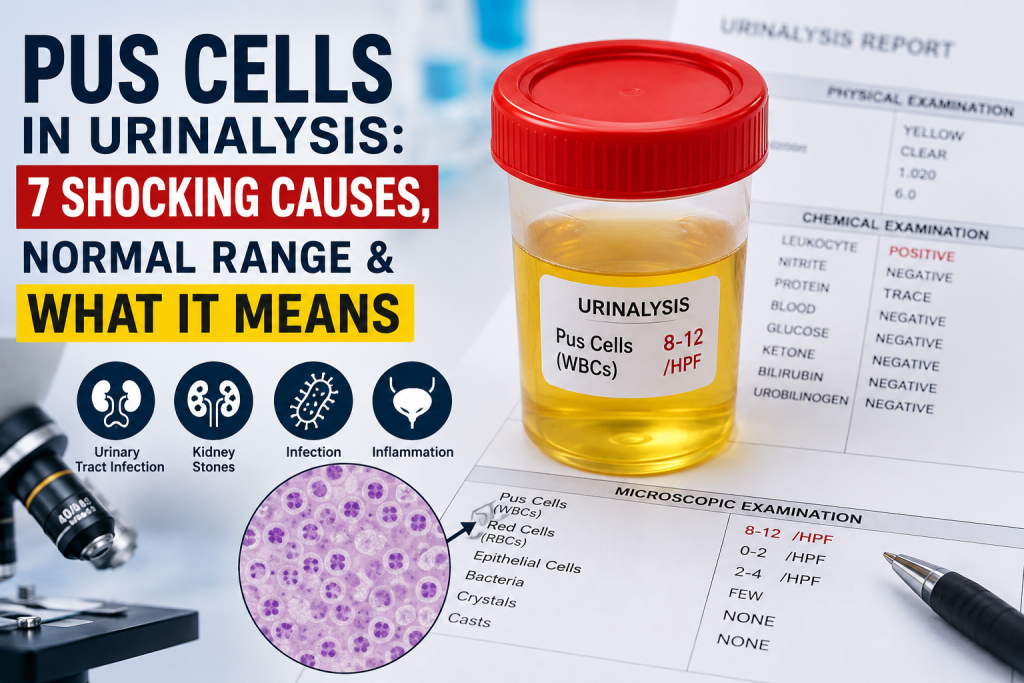
Pus Cells in Urinalysis: 7 Shocking Causes, Normal Range & What It Means
Seeing the words Pus Cells in Urinalysis on a laboratory report can be confusing, especially when you are not sure whether the result is normal or a sign of infection. Pus cells generally refer to white blood cells found in urine. A small number may sometimes appear in a urine sample, while a higher number can indicate inflammation, infection, or another urinary problem.
The meaning of the result depends on several factors, including the number of cells reported, symptoms, the method used by the laboratory, and other urine findings. A result should therefore be interpreted in context rather than treated as a diagnosis on its own.
This guide explains what Pus Cells in Urinalysis means, the normal range, common causes of increased white blood cells in urine, symptoms to watch for, testing options, and when medical evaluation may be appropriate.
What Are Pus Cells in Urinalysis?

The term Pus Cells in Urinalysis usually describes white blood cells, also called leukocytes, detected during microscopic examination of urine. White blood cells are part of the immune system and help the body respond to infections and inflammation.
When white blood cells enter the urinary tract in increased numbers, they may be reported as pus cells. The finding is sometimes associated with a urinary tract infection (UTI), but infection is not the only possible explanation.
A laboratory report may express the result as cells per high-power field (HPF), such as 0–2, 2–5, 5–10, or a higher number. Some laboratories may use different reporting systems or reference ranges, so the range printed on the report should be considered when interpreting the result.
What Is the Normal Range?

There is no single universal number that applies to every laboratory. In many urine microscopy reports, a small number of white blood cells may be considered within or close to the expected range.
For example, some laboratories may describe approximately 0–5 white blood cells per high-power field as a typical reference range. However, laboratory methods and reference intervals can differ.
Therefore, if your report shows a value slightly above the laboratory’s reference range, it does not automatically mean you have a serious condition.
The result becomes more meaningful when combined with symptoms and other findings, such as bacteria, nitrites, leukocyte esterase, blood, protein, or changes in urine appearance.
7 Common Causes of Increased Pus Cells
There are several reasons why white blood cells may appear in urine. Some are common and easily treatable, while others require further investigation.
1. Urinary Tract Infection

A urinary tract infection is one of the most common reasons for increased white blood cells in urine. A UTI can affect different parts of the urinary system, including the bladder and urethra.
Typical symptoms can include burning or discomfort while urinating, frequent urination, an urgent need to urinate, lower abdominal discomfort, and cloudy or strong-smelling urine.
When Pus Cells in Urinalysis are accompanied by urinary symptoms and other findings suggesting infection, a healthcare professional may recommend additional testing, such as a urine culture.
It is important not to assume that every elevated result is a UTI. Proper evaluation can help determine the actual cause.
2. Kidney Infection
A kidney infection can develop when bacteria reach the kidneys. It can cause more significant symptoms than a lower urinary tract infection.
Possible symptoms include fever, chills, pain in the side or back, nausea, vomiting, and urinary symptoms.
A person with urinary white blood cells plus fever or significant flank pain should seek medical attention promptly. Kidney infections can require timely treatment to prevent complications.
3. Kidney or Urinary Stones

Kidney stones can irritate the lining of the urinary tract and cause inflammation. This irritation may result in white blood cells appearing in urine.
Stones may also cause severe pain in the back, side, lower abdomen, or groin. Blood in the urine can occur as well.
The presence of Pus Cells in Urinalysis does not by itself prove that a person has kidney stones. Imaging and other tests may be needed when symptoms suggest a stone.
4. Inflammation of the Urinary Tract
Inflammation can occur without a typical bacterial infection. Irritation of the bladder, urethra, or other parts of the urinary system may contribute to white blood cells in a urine sample.
Different conditions can cause urinary inflammation, so persistent findings may require further assessment.
If urinary symptoms continue despite a negative urine culture, a healthcare professional may investigate other possible causes rather than repeatedly assuming a bacterial infection.
5. Sexually Transmitted Infections

Certain sexually transmitted infections can cause inflammation in the urinary or genital tract. Depending on the infection, symptoms may include burning during urination, discharge, pelvic discomfort, or sometimes no noticeable symptoms.
A routine urine examination may not identify the specific cause. When an STI is possible, appropriate laboratory testing is more useful than relying only on the presence of white blood cells.
People with symptoms or potential exposure should discuss testing confidentially with a qualified healthcare professional.
6. Contamination of the Urine Sample
Not every abnormal urine result originates from inside the urinary tract. A sample can become contaminated during collection, particularly when the collection process is not performed carefully.
For example, cells from surrounding skin or genital areas may enter the specimen and affect the result.
This is one reason healthcare professionals may recommend repeating a urine test when the result does not match the person’s symptoms.
A clean-catch midstream urine sample can help reduce the chance of contamination.
7. Other Medical Conditions or Medications

Less common causes can also produce white blood cells in urine. These may include certain inflammatory kidney conditions, some medication-related kidney problems, and other urinary disorders.
The possibility becomes more important when white blood cells remain elevated repeatedly without a clear infection.
Persistent abnormal findings should be evaluated based on the person’s medical history, medications, symptoms, kidney function, and other laboratory results.
Symptoms That May Occur Alongside High Pus Cells

The symptoms associated with increased white blood cells depend on the underlying cause.
Some people may experience:
- Burning or pain during urination
- Frequent urination
- Urgency to urinate
- Lower abdominal discomfort
- Cloudy urine
- Blood in the urine
- Strong-smelling urine
- Side or back pain
- Fever or chills
- Nausea or vomiting
However, some people have no symptoms at all. An abnormal urine finding may be discovered during a routine examination.
This is why the laboratory result should be interpreted together with the person’s overall clinical picture.
How Is the Cause Diagnosed?

If Pus Cells in Urinalysis are elevated, a healthcare professional may review the complete urine report rather than looking at one number alone.
A standard urinalysis can provide information about white blood cells, red blood cells, bacteria, protein, glucose, blood, nitrites, leukocyte esterase, and other characteristics.
Depending on the situation, a urine culture may be performed. A culture can help determine whether certain bacteria are present and may help guide antibiotic treatment when a bacterial infection is confirmed.
Other tests may be considered when symptoms or medical history suggest a different cause. These can include blood tests, kidney function testing, STI testing, or imaging studies.
The appropriate testing depends on the individual situation.
Does a High Result Always Mean a UTI?
No. This is an important point.
A high number of white blood cells can occur with a UTI, but it can also result from stones, inflammation, contamination, certain medical conditions, or other causes.
Likewise, a person can have urinary symptoms without having a bacterial UTI.
For this reason, antibiotics should not be started simply because a urine report contains white blood cells. A healthcare professional can determine whether treatment is appropriate based on symptoms, test results, and individual risk factors.
When Should You See a Doctor?
A mildly abnormal urine result without symptoms may not always require emergency attention, but it is worth discussing with a healthcare professional if it persists or if other abnormalities are present.
Prompt medical assessment is particularly important when urinary findings are accompanied by:
- High fever
- Chills
- Severe back or side pain
- Vomiting
- Visible blood in the urine
- Difficulty passing urine
- Severe or rapidly worsening symptoms
These symptoms can sometimes indicate a more significant urinary or kidney problem.
Pregnant people, children, older adults, and people with certain underlying health conditions may require individualized evaluation.
How Is It Treated?
Treatment depends entirely on the underlying cause.
If a bacterial UTI is confirmed or strongly suspected by a healthcare professional, appropriate antibiotics may be prescribed. The specific medicine depends on factors such as the suspected organism, local resistance patterns, allergies, pregnancy status, and individual medical history.
If kidney stones are responsible, treatment may focus on stone size, location, symptoms, and whether the urinary tract is blocked.
If an STI is suspected, appropriate testing and targeted treatment are needed.
When contamination is suspected, repeating the urine test with proper collection technique may be recommended.
The key point is that Pus Cells in Urinalysis are a finding, not a disease. Treatment should target the condition causing the finding rather than the white blood cells themselves.
Can You Prevent Increased Pus Cells?
There is no single way to prevent every cause of white blood cells in urine. However, several general habits may support urinary health.
Drinking adequate fluids according to your individual needs can help maintain normal urine production. Avoiding unnecessary use of antibiotics can also reduce the risk of antibiotic resistance.
Good personal hygiene and appropriate sexual health practices may reduce the risk of some infections.
People who repeatedly develop urinary symptoms should discuss possible contributing factors with a healthcare professional rather than repeatedly self-treating.
Understanding Your Urine Report
When reviewing Pus Cells in Urinalysis, look at the entire report rather than focusing on one number.
For example, a report might include:
- White blood cells or pus cells
- Red blood cells
- Bacteria
- Nitrite
- Leukocyte esterase
- Protein
- Glucose
- Specific gravity
- pH
The combination of these findings can provide more useful information than any single result.
For example, white blood cells together with urinary symptoms and findings that support bacterial infection may make a UTI more likely. On the other hand, white blood cells with repeated negative cultures may encourage a healthcare professional to consider other causes.
Frequently Asked Questions
What does Pus Cells in Urinalysis mean?
It generally means that white blood cells have been detected in a urine sample. A small number may occur, while increased numbers can be associated with infection or inflammation. The result needs to be interpreted according to the laboratory’s reference range and the person’s symptoms.
Are 5–10 pus cells dangerous?
Not necessarily. The significance depends on the laboratory reference range, symptoms, and other urine findings. A result of 5–10 cells per high-power field may be considered elevated by some laboratories, but it does not automatically indicate a serious condition.
Can pus cells disappear without treatment?
That depends on the cause. Some temporary or contaminated results may normalize, while an infection or another underlying condition may persist or worsen without appropriate care.
Can dehydration cause pus cells in urine?
Dehydration can make urine more concentrated, but it should not automatically be considered the explanation for elevated white blood cells. If the result is abnormal, the full urine report and clinical symptoms should be considered.
Should I take antibiotics for high pus cells?
Not automatically. White blood cells alone do not prove a bacterial infection. Antibiotics should be used when a qualified healthcare professional determines that they are appropriate.
Final Thoughts
An abnormal urine report can understandably cause concern, but Pus Cells in Urinalysis should be viewed as one piece of information rather than a diagnosis. Increased white blood cells may occur because of a UTI, kidney infection, urinary stones, inflammation, STI-related conditions, sample contamination, or other medical issues.
The normal range can vary between laboratories, so always compare your result with the reference range printed on your report. If you have symptoms such as burning urination, fever, severe side or back pain, blood in the urine, or vomiting, medical evaluation is especially important.
The most useful approach is to consider the urine result together with symptoms and other laboratory findings. When the cause is unclear or the abnormal result continues, a healthcare professional can recommend the appropriate testing and treatment.