
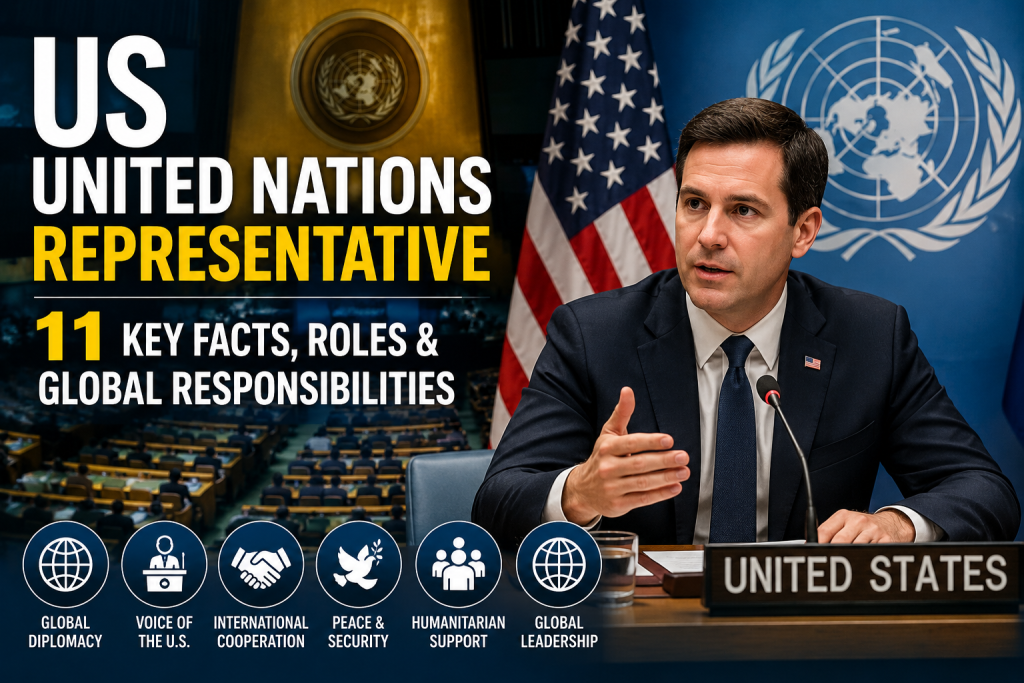
US United Nations Representative: 11 Key Facts, Roles & Global Responsibilities
Introduction
The US United Nations Representative plays one of the most influential diplomatic roles in international affairs. As the official representative of the United States at the United Nations (UN), this position serves as the primary voice of the U.S. government during discussions on global peace, security, humanitarian issues, climate change, human rights, economic development, and international cooperation.
The United Nations brings together nearly every country in the world to address common challenges that no single nation can solve alone. In this setting, the US United Nations Representative helps shape American foreign policy while working with leaders from around the globe to negotiate agreements, respond to international crises, and strengthen diplomatic relationships.
Understanding the responsibilities of the US United Nations Representative provides valuable insight into how the United States influences global decision-making and international diplomacy.
What Is the US United Nations Representative?

The US United Nations Representative is the chief diplomat representing the United States at the United Nations headquarters in New York City. This official is commonly referred to as the U.S. Ambassador to the United Nations and serves as the permanent representative of the United States to the UN.
The ambassador communicates America’s official position on international matters and participates in meetings of the UN General Assembly, the Security Council when applicable, and numerous committees responsible for global cooperation.
The US United Nations Representative works closely with the President of the United States, the Secretary of State, the Department of State, and other government agencies to ensure American foreign policy is accurately represented on the international stage.
History of the Position
The position of US United Nations Representative was established after the founding of the United Nations in 1945 following the end of World War II. The creation of the UN marked a new era of international diplomacy aimed at preventing future global conflicts through peaceful cooperation.
Since then, many distinguished diplomats have served as the American representative to the United Nations. Throughout history, each representative has faced different international challenges, including the Cold War, regional conflicts, humanitarian emergencies, terrorism, nuclear security, global health crises, and climate-related issues.
Although administrations change over time, the overall mission of the US United Nations Representative remains focused on advancing U.S. interests while supporting international cooperation.
Main Responsibilities
The responsibilities of the US United Nations Representative extend far beyond attending meetings. The ambassador serves as America’s chief spokesperson during UN debates and negotiations involving international peace and security.
The representative participates in discussions concerning armed conflicts, sanctions, humanitarian aid, refugee protection, peacekeeping operations, international law, economic development, environmental protection, and global public health.
Another important responsibility involves negotiating resolutions with representatives from other member nations. Diplomatic negotiation often requires balancing national interests while seeking solutions acceptable to multiple countries.
The US United Nations Representative also regularly communicates with U.S. government officials to ensure that international negotiations align with American foreign policy objectives.
Role Within the United Nations
The United Nations operates through several major organizations, including the General Assembly, the Security Council, the Economic and Social Council, and numerous specialized agencies.
The US United Nations Representative actively participates in these institutions by presenting official U.S. positions, voting on resolutions where applicable, engaging in diplomatic discussions, and collaborating with international partners.
Because the United States is one of the world’s largest economies and a permanent member of the UN Security Council, the ambassador often plays a significant role during discussions involving international peace, sanctions, conflict resolution, and humanitarian emergencies.
Appointment Process

The US United Nations Representative is nominated by the President of the United States. After nomination, the candidate generally undergoes a confirmation process in the United States Senate before officially assuming office.
Once confirmed, the ambassador represents the United States at the United Nations and serves according to the policies established by the President and the Department of State.
This appointment requires extensive diplomatic experience, knowledge of international relations, negotiation skills, and a strong understanding of global political issues.
Skills Required
Serving as the US United Nations Representative requires exceptional communication and leadership abilities. Diplomats in this role must negotiate effectively while maintaining positive relationships with representatives from countries that may have very different political systems and national interests.
Strong public speaking skills are essential because the ambassador frequently addresses international audiences during official UN meetings.
Critical thinking, strategic planning, cultural awareness, conflict resolution, and deep knowledge of international law also contribute to successful diplomatic leadership.
Influence on Global Diplomacy

The US United Nations Representative plays an important role in shaping international diplomacy. Every statement delivered at the United Nations reflects the official foreign policy position of the United States and can influence global discussions on peace, security, trade, climate action, and humanitarian assistance.
The ambassador regularly meets with diplomats from other countries to negotiate agreements, resolve disagreements, and encourage cooperation on shared global challenges. These diplomatic efforts often take place behind closed doors before resolutions are formally presented to the United Nations.
Because the United States is one of the founding members of the UN, the US United Nations Representative frequently participates in discussions that attract worldwide attention.
Working With International Organizations
The United Nations consists of numerous specialized agencies that address different global issues. The US United Nations Representative works closely with organizations involved in public health, education, refugee protection, food security, children’s welfare, and international development.
Collaboration with these organizations allows the United States to contribute to humanitarian relief efforts, disaster response, disease prevention, economic development, and peacekeeping operations around the world.
International cooperation often requires balancing national interests while supporting broader global objectives.
Challenges Faced by the US United Nations Representative
Serving as the US United Nations Representative involves handling some of the world’s most difficult political challenges.
International conflicts, humanitarian crises, climate change, terrorism, cyber security, nuclear non-proliferation, migration, food shortages, and global health emergencies require constant diplomatic engagement.
Negotiating with countries that hold different political views can be extremely challenging. The ambassador must protect American interests while maintaining constructive diplomatic relationships.
Media attention also creates additional pressure because statements made by the US United Nations Representative are closely followed by governments, journalists, and international organizations.
Relationship With the President and Secretary of State
The US United Nations Representative works closely with the President of the United States and the Secretary of State to ensure American foreign policy is consistently represented at the United Nations.
Although the ambassador participates in international negotiations, major foreign policy decisions remain under the authority of the President and the U.S. government.
Regular communication between Washington and the U.S. Mission to the United Nations helps coordinate diplomatic priorities and responses to rapidly changing international events.
Importance of the Position
The position of US United Nations Representative is important because many global issues require international cooperation rather than action by a single country.
Peacekeeping missions, humanitarian assistance, sanctions, international law, refugee protection, environmental agreements, and global security initiatives all depend on diplomatic negotiation among member states.
The representative serves as America’s official voice during these discussions, helping shape decisions that may affect millions of people worldwide.
Strong diplomacy can reduce conflict, encourage cooperation, and support international stability.
The Future of the Role
The responsibilities of the US United Nations Representative continue to evolve as new global challenges emerge.
Issues such as artificial intelligence, cybersecurity, climate change, pandemics, energy security, international trade, and technological innovation increasingly influence diplomatic discussions.
Future ambassadors will likely spend even more time negotiating solutions to complex global problems that require cooperation between governments, international organizations, businesses, and civil society.
Regardless of changing political priorities, the US United Nations Representative will remain one of America’s most significant diplomatic positions.
Conclusion
The US United Nations Representative serves as the chief diplomatic representative of the United States at the United Nations, representing American interests while promoting international cooperation.
From participating in Security Council discussions to negotiating global agreements, supporting humanitarian efforts, and addressing international crises, the ambassador plays a central role in modern diplomacy.
As global challenges continue to grow in complexity, the importance of the US United Nations Representative will remain significant. Through effective diplomacy, negotiation, and international engagement, this position helps strengthen cooperation among nations while advancing peace, security, and sustainable development around the world.
Frequently Asked Questions
Who is the US United Nations Representative?
The US United Nations Representative is the official ambassador who represents the United States at the United Nations and speaks on behalf of the U.S. government during international meetings.
What does the US United Nations Representative do?
The US United Nations Representative participates in UN meetings, negotiates international agreements, votes on resolutions where applicable, and represents U.S. foreign policy on global issues.
How is the US United Nations Representative selected?
The US United Nations Representative is nominated by the President of the United States and generally confirmed by the U.S. Senate before taking office.
Where does the US United Nations Representative work?
The US United Nations Representative primarily works at the United Nations Headquarters in New York City while coordinating with the U.S. Department of State and other government agencies.
Why is the US United Nations Representative important?
The US United Nations Representative plays a key role in international diplomacy by representing American interests, participating in global negotiations, supporting peace initiatives, and strengthening cooperation between the United States and other UN member nations.