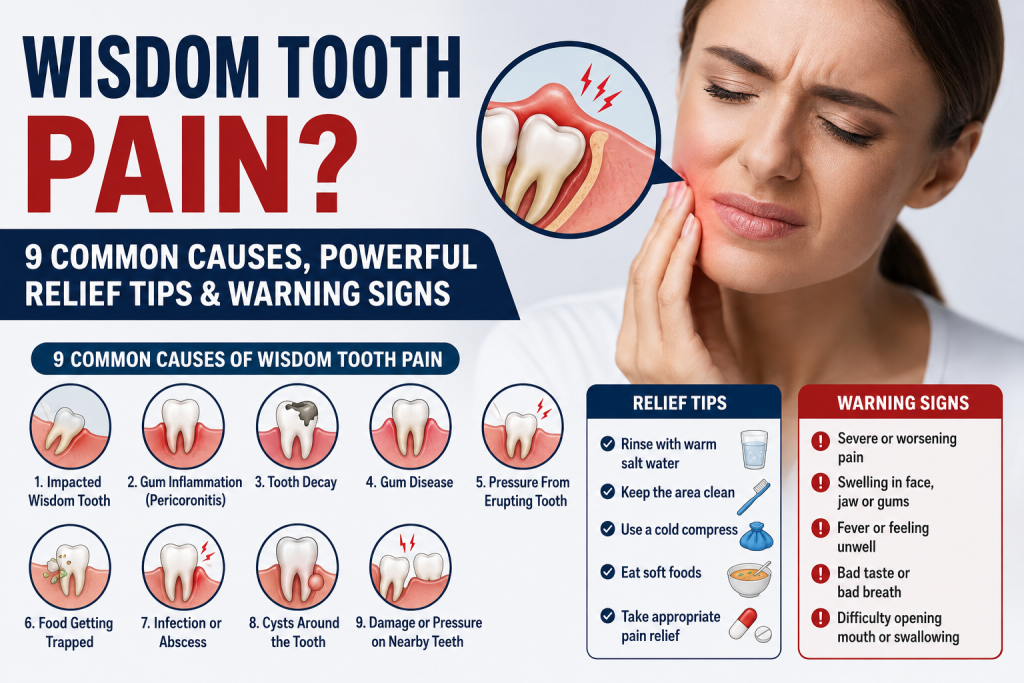
Wisdom Tooth Pain: 9 Common Causes, Powerful Relief Tips & Warning Signs
Wisdom tooth pain can be uncomfortable, distracting, and sometimes surprisingly intense. The pain usually develops at the very back of the mouth, where wisdom teeth are located. For some people, these teeth grow normally without causing problems. For others, limited space, infection, gum inflammation, tooth decay, or impaction can lead to significant discomfort.
Wisdom teeth are the third and final set of molars. They commonly appear during the late teenage years or early adulthood, although the timing can vary from person to person. Not everyone develops all four wisdom teeth, and some people never experience problems with them.
If you are experiencing wisdom tooth pain, understanding the possible causes can help you know what steps to take. Mild discomfort may sometimes be managed temporarily at home, but persistent or severe dental pain should be assessed by a dentist.
What Is Wisdom Tooth Pain?
Wisdom tooth pain refers to discomfort around one or more third molars at the back of the mouth. The pain may feel dull and aching, sharp, throbbing, or tender when you chew.
It can affect the gum around the tooth, the jaw, or nearby teeth. Some people may also notice swelling, bad breath, a bad taste, or difficulty opening their mouth.
The symptoms can occur gradually as a wisdom tooth begins to erupt or suddenly when an infection or other dental problem develops.
Because several dental conditions can cause similar symptoms, it is not always possible to identify the cause without a dental examination.
9 Common Causes of Wisdom Tooth Pain
There are several reasons why wisdom tooth pain can develop. Some are directly related to the position of the tooth, while others involve the surrounding gums or nearby teeth.
1. Impacted Wisdom Teeth
One of the most common reasons for wisdom tooth pain is impaction.
An impacted wisdom tooth does not have enough space to erupt normally. It may remain partly or completely trapped beneath the gum or jawbone. In some cases, the tooth grows at an angle and presses against another tooth.
Impacted wisdom teeth can contribute to pain, swelling, gum problems, tooth decay, and infection. Dental X-rays are often used to determine the position of the tooth.
Possible symptoms include:
- Pain at the back of the mouth
- Jaw tenderness
- Swollen gums
- Difficulty opening the mouth
- Bad breath
- Bad taste
- Pain around nearby teeth
If an impacted tooth is causing ongoing symptoms, a dentist can determine whether monitoring, treatment, or removal is appropriate.
2. Gum Inflammation Around a Partially Erupted Tooth
Another cause of wisdom tooth pain is inflammation around a wisdom tooth that has only partially erupted.
When part of the tooth is covered by gum tissue, food particles and bacteria can become trapped around it. This can lead to inflammation and infection of the surrounding gum.
This condition is commonly called pericoronitis.
Symptoms may include:
- Pain around the back molar
- Red or swollen gums
- Bad taste
- Bad breath
- Difficulty chewing
- Difficulty opening the mouth
- Facial or jaw swelling
NHS guidance lists pericoronitis among problems that may occur when wisdom teeth do not have enough room to emerge properly.
3. Tooth Decay
Tooth decay can also cause wisdom tooth pain.
Wisdom teeth are located far back in the mouth, which can make them difficult to brush and floss effectively. When plaque and food debris accumulate around the tooth, bacteria can contribute to cavities.
A decayed wisdom tooth may cause:
- Sensitivity
- Pain when chewing
- Sensitivity to hot or cold foods
- Persistent toothache
- A damaged or visible cavity
NHS information identifies tooth decay as one possible cause of toothache and notes that wisdom teeth that break through without enough space may become infected.
4. Gum Disease
Poor cleaning around a wisdom tooth can also contribute to gum disease.
If plaque remains around the tooth, the gums can become irritated and inflamed. In more advanced cases, gum disease can affect the tissues supporting the teeth.
You may notice:
- Red gums
- Swollen gums
- Bleeding when brushing
- Bad breath
- Tenderness around the wisdom tooth
Good oral hygiene and regular dental examinations can help reduce the risk of gum problems.
5. Pressure From an Erupting Wisdom Tooth
Sometimes wisdom tooth pain occurs because a tooth is actively erupting through the gum.
As the tooth moves into position, you may experience pressure or tenderness around the back of the jaw. Some discomfort can occur during normal eruption, but significant or persistent pain should not automatically be considered normal.
The American Dental Association explains that some discomfort can occur when wisdom teeth appear, but recommends seeing a dentist if you have pain.
6. Food Getting Trapped
Food can become trapped around a partially erupted wisdom tooth.
Because the area can be difficult to clean, trapped food may irritate the gum and encourage bacterial growth. This can contribute to inflammation, bad breath, unpleasant taste, and wisdom tooth pain.
Gentle cleaning and regular dental care can help, but if the area repeatedly becomes painful, a dentist should examine it.
7. Infection or Dental Abscess
A dental infection can cause severe wisdom tooth pain.
An infection may develop around the tooth or in the surrounding gum tissue. In some cases, an abscess can form.
Possible symptoms include:
- Severe or throbbing pain
- Facial swelling
- Gum swelling
- Pus
- Bad taste
- Fever
- Feeling generally unwell
A dental abscess requires professional dental treatment and should not be ignored. Antibiotics may sometimes be needed, but treatment depends on the underlying dental problem.
8. Cysts Around an Impacted Tooth
Although less common, a cyst can develop around an impacted wisdom tooth.
A cyst is a fluid-filled sac that can develop around a tooth. Some cysts cause no symptoms initially, while others can affect nearby structures.
A dentist can identify these problems using an examination and dental imaging.
9. Damage or Pressure on Nearby Teeth
An incorrectly positioned wisdom tooth may push against a neighboring molar or make the surrounding area difficult to clean.
This can contribute to discomfort and increase the risk of decay or gum problems around the nearby tooth.
Cleveland Clinic notes that impacted wisdom teeth can cause oral health problems including infection, tooth decay, gum disease, and damage to other teeth.
What Does Wisdom Tooth Pain Feel Like?
The experience of wisdom tooth pain can vary depending on its cause.
You might feel:
- A dull ache
- Sharp pain
- Throbbing pain
- Gum tenderness
- Jaw pressure
- Pain when chewing
- Pain that spreads toward the jaw or face
- Sensitivity around the back molar
Some people experience symptoms that come and go, while others develop continuous discomfort.
If pain continues, becomes worse, or is accompanied by swelling or fever, professional dental evaluation is recommended.
Can Wisdom Tooth Pain Cause Headaches?
In some cases, problems involving wisdom teeth can be associated with jaw pain and headaches.
Pain from the jaw or surrounding tissues may sometimes be felt in other areas of the head. However, headaches have many possible causes, so a headache should not automatically be attributed to a wisdom tooth.
If you have a headache together with pain around the back of your mouth or jaw, a dentist can determine whether a dental problem may be contributing.
How to Get Temporary Relief From Wisdom Tooth Pain
If you have mild wisdom tooth pain while waiting for a dental appointment, several simple measures may provide temporary comfort.
1. Rinse With Warm Salt Water
A warm saltwater rinse can help keep the mouth clean and may soothe irritated gums.
The NHS recommends dissolving half a teaspoon of salt in a glass of warm water, rinsing, and spitting the solution out rather than swallowing it.
2. Keep the Area Clean
Continue brushing your teeth carefully and clean between your teeth as appropriate.
The area around a wisdom tooth can be difficult to reach, but good oral hygiene is important because food and plaque can accumulate there.
Avoid aggressive brushing directly over painful or swollen tissue.
3. Use a Cold Compress
A cold pack wrapped in a towel can be applied to the outside of the cheek for short periods to help with discomfort and swelling.
Do not apply ice directly to your skin.
4. Choose Softer Foods
If chewing makes your wisdom tooth pain worse, choose softer foods temporarily.
Examples include:
- Yogurt
- Soup that has cooled to a comfortable temperature
- Mashed vegetables
- Soft rice
- Scrambled eggs
- Oatmeal
Avoid foods that are very hard, crunchy, or likely to become trapped around the tooth.
5. Consider Appropriate Pain Relief
Over-the-counter pain medicines may help some people with dental pain. The American Dental Association provides evidence-based guidance for managing acute dental pain.
However, medication is not a substitute for treating the underlying dental problem.
Follow the medicine’s label instructions and ask a pharmacist or healthcare professional if you are unsure which option is appropriate for you.
When Should You See a Dentist?
Persistent wisdom tooth pain should be evaluated by a dentist, especially if it keeps returning.
Make a dental appointment if you have:
- Pain that does not improve
- Repeated swelling
- Difficulty chewing
- Bad breath that persists
- Bad taste around the tooth
- Bleeding or swollen gums
- Difficulty opening your mouth
- A damaged or decayed wisdom tooth
A dentist may examine your mouth and take an X-ray to determine how the wisdom tooth is positioned.
When Is Wisdom Tooth Pain an Emergency?
Some symptoms require urgent dental or medical attention.
Seek urgent help if you have severe or worsening pain accompanied by significant swelling, fever, feeling unwell, or a bad taste associated with an apparent infection.
Difficulty breathing or swallowing is particularly important and requires urgent medical attention because swelling from a dental infection can become serious.
NHS guidance recommends urgent dental help for severe or worsening pain and swelling, particularly when painkillers are not helping, as well as pain accompanied by a bad taste, high temperature, or feeling unwell.
Does Every Wisdom Tooth Need to Be Removed?
No. Not every wisdom tooth needs to be removed.
If a wisdom tooth has erupted normally, is healthy, can be cleaned properly, and is not causing problems, a dentist may simply monitor it during routine examinations.
However, removal may be considered when the tooth is causing problems such as:
- Repeated infection
- Significant pain
- Tooth decay
- Gum disease
- Cysts
- Damage to nearby teeth
- Impaction
The decision should be made after a dental examination and, when appropriate, dental X-rays.
What Happens During Wisdom Tooth Removal?
If a dentist or oral surgeon recommends removal, the procedure generally involves numbing the area and removing the tooth.
An impacted tooth may require a small incision in the gum and, in some cases, removal of a small amount of bone to access the tooth.
After removal, some pain, swelling, jaw stiffness, or bruising can occur. Recovery varies depending on the complexity of the extraction.
NHS guidance states that pain and swelling after wisdom tooth removal commonly begin improving within the first few days, although some symptoms can continue for up to around two weeks.
How Can You Prevent Wisdom Tooth Problems?
You cannot always prevent an impacted wisdom tooth because its position and available jaw space are important factors.
However, you can reduce the risk of related dental problems by maintaining good oral hygiene.
Helpful habits include:
- Brush your teeth twice a day with fluoride toothpaste.
- Clean between your teeth regularly.
- Pay careful attention to hard-to-reach back teeth.
- Attend routine dental checkups.
- Avoid excessive sugary foods and drinks.
- Tell your dentist about new or recurring pain.
Regular dental care can help identify wisdom tooth problems before they become more serious.
Frequently Asked Questions About Wisdom Tooth Pain
How long does wisdom tooth pain last?
The duration varies depending on the cause. Mild irritation may settle temporarily, while pain caused by infection, impaction, decay, or another dental problem may persist or return until the underlying issue is treated.
Why does my wisdom tooth hurt at night?
Wisdom tooth pain may feel more noticeable at night because there are fewer distractions and you are more aware of discomfort. However, nighttime pain can also occur with dental inflammation, decay, or infection.
Persistent nighttime pain should be discussed with a dentist.
Can wisdom tooth pain go away on its own?
Sometimes mild discomfort may temporarily improve, but recurring or persistent pain should not be ignored. Dental problems such as infection or decay generally require appropriate professional care.
Can I remove a wisdom tooth myself?
No. A wisdom tooth should only be removed by a qualified dental professional. Attempting to remove it yourself can cause serious injury, bleeding, infection, or damage to surrounding structures.
Is wisdom tooth pain normal?
Some mild discomfort can occur when wisdom teeth erupt, but significant, persistent, or worsening pain should be evaluated. Pain can indicate impaction, infection, decay, gum inflammation, or another dental problem.
Can an impacted wisdom tooth cause swelling?
Yes. An impacted or partially erupted wisdom tooth can be associated with swollen gums, jaw swelling, and other symptoms, particularly when inflammation or infection develops.
Final Thoughts
Wisdom tooth pain can have many causes, including impaction, gum inflammation, tooth decay, infection, food trapped around the tooth, and pressure on nearby teeth.
While simple measures such as warm saltwater rinses, careful oral hygiene, softer foods, and appropriate over-the-counter pain relief may provide temporary comfort, they do not necessarily treat the underlying cause.
If your wisdom tooth pain is persistent, severe, or repeatedly returns, arrange a dental examination. A dentist can examine the tooth, take an X-ray when necessary, and determine whether monitoring, dental treatment, or wisdom tooth removal is appropriate.
Most importantly, do not ignore severe swelling, fever, worsening pain, or difficulty breathing or swallowing. These symptoms can indicate a more serious dental infection and require urgent professional care.