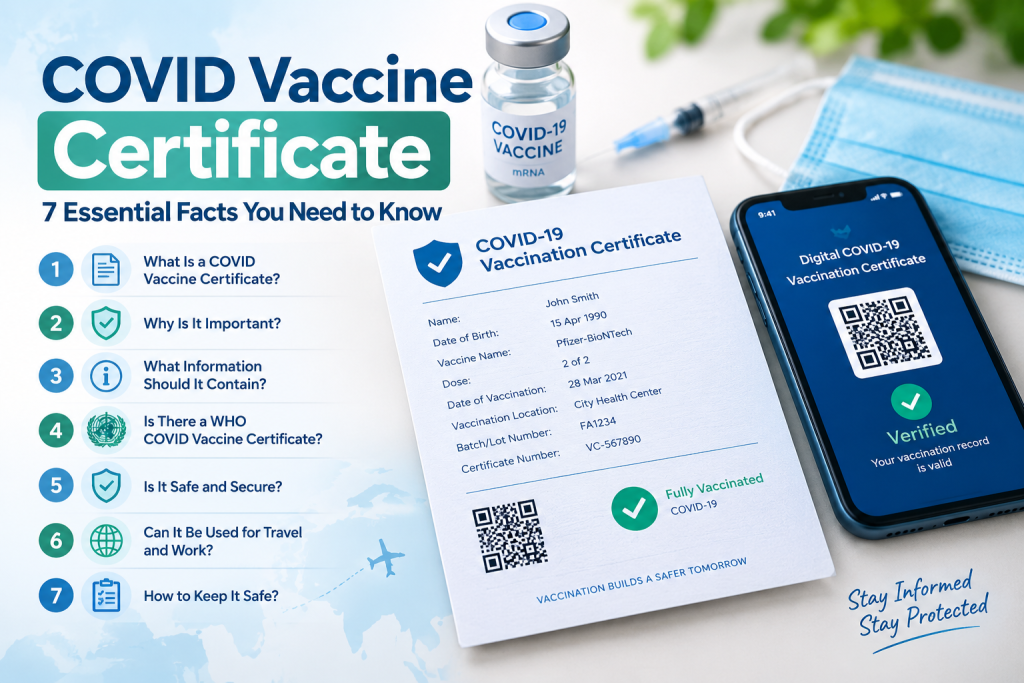
COVID Vaccine Certificate: 7 Essential Facts You Need to Know
A COVID Vaccine Certificate is an official record showing that a person has received a COVID-19 vaccination. Depending on the country and health system, this record may be available as a printed document, vaccination card, digital certificate, or QR-code-based record.
During the COVID-19 pandemic, vaccination certificates became important for documenting vaccination status, accessing certain services, and, in some situations, meeting travel or workplace requirements. Although many COVID-related restrictions have changed, vaccination records can still be useful for personal healthcare records and for verifying previous vaccinations.
The World Health Organization (WHO) explains that vaccination certificates can document important details about a vaccination event, including the vaccine administered and the date of vaccination. Digital systems can make these records easier to store, retrieve, and verify.
If you have an old vaccination card or digital record, it is a good idea to keep it safely stored. Here are seven essential facts you should know about a COVID Vaccine Certificate.
1. What Is a COVID Vaccine Certificate?
A COVID Vaccine Certificate is a document or digital record that confirms that an individual received a COVID-19 vaccine.
The certificate may contain information such as:
- Your name
- Date of birth or identification information
- Date of vaccination
- Vaccine name or type
- Dose information
- Vaccination location
- Vaccine batch or lot number
- Certificate or identification number
- QR code or barcode, depending on the system
Not every certificate contains exactly the same information. The format depends on the country, healthcare provider, and system that issued the record.
The main purpose is to provide reliable evidence that a vaccination took place. WHO’s digital documentation guidance describes vaccination certificates as records that can be used to establish vaccination status and support continuing healthcare.
A certificate is different from a medical diagnosis. It does not prove that someone is currently healthy, does not prove that they cannot become infected, and does not guarantee complete protection from COVID-19.
Instead, it documents a specific vaccination event.
2. Why Is a COVID Vaccine Certificate Important?
A vaccination record can be useful for several reasons.
First, it helps you keep track of your vaccination history. If you received multiple doses over time, having an accurate record makes it easier to understand which doses you received and when.
Second, healthcare professionals may use vaccination records when considering future vaccination or healthcare needs.
Third, some organizations or authorities may request vaccination documentation for specific purposes. Requirements can vary considerably by country, organization, or situation.
WHO’s technical guidance lists several potential uses for vaccination documentation, including continuity of care, vaccination monitoring, work, education, and certain travel-related applications.
However, the importance of a COVID Vaccine Certificate today may be different from its importance during the peak of the pandemic. Many countries have removed COVID-specific entry requirements, but this does not mean that your vaccination history is useless.
Keeping healthcare records organized is generally helpful, especially if your healthcare provider needs information about previous vaccinations.
3. What Information Should a COVID Vaccine Certificate Contain?
A valid certificate should contain enough information to identify the vaccination event and connect it with the correct person.
Depending on the issuing system, your certificate may show:
Personal Information
Your name and another identifying detail may appear on the document. This helps prevent confusion between records belonging to different people.
Vaccination Date
The date of vaccination is one of the most important pieces of information. It establishes when the dose was administered.
Vaccine Information
The certificate may identify the vaccine product or type that was administered.
Dose Information
If you received more than one dose, your vaccination record may show the number or sequence of doses.
Identification Number
Some systems use a certificate number, health identification number, or another unique identifier.
QR Code or Barcode
Digital certificates may contain a QR code or barcode that allows authorized systems to verify information.
WHO’s digital certificate specifications include provisions for electronic certificates and machine-readable codes such as QR formats.
It is important to remember that the exact appearance and information on a COVID Vaccine Certificate can differ between countries.
For this reason, you should obtain your certificate from an official government, healthcare, or vaccination system rather than relying on unofficial websites.
4. Is There a WHO COVID Vaccine Certificate?
One common misunderstanding is that the World Health Organization personally issues a COVID vaccination certificate to every vaccinated person.
It does not.
WHO and PAHO explain that WHO does not maintain a worldwide personal database of people vaccinated against COVID-19 and does not issue an individual international COVID-19 vaccination certificate. Government authorities in each country are responsible for issuing their own vaccination documentation.
This distinction is important.
If someone offers to sell you a “WHO COVID vaccine certificate” or claims that you need a special WHO certificate, be cautious. Your legitimate vaccination record normally comes from the relevant national or local health authority or healthcare provider.
WHO has developed technical standards and guidance for digital documentation, but this is different from personally issuing certificates to individuals.
The organization has worked on standards designed to help countries create systems that can document and verify vaccination information securely.
5. Can You Use a COVID Vaccine Certificate for International Travel?
This is one of the most important questions people have about a COVID Vaccine Certificate.
Travel requirements have changed significantly since the height of the pandemic. Whether vaccination documentation is required depends on the destination country, transit countries, airline policies, and current public health rules.
You should always check the latest requirements from official authorities before traveling.
A vaccination certificate may provide evidence of your vaccination history, but it does not automatically mean that every country will accept it as a travel document.
WHO has also emphasized that countries should make travel-related decisions according to risk assessments and applicable public health requirements.
Another important point is that COVID vaccination documentation should not be confused with the International Certificate of Vaccination or Prophylaxis, commonly associated with the yellow vaccination booklet.
The international certificate system is particularly relevant to diseases for which vaccination may be required under international health regulations, such as yellow fever in certain travel situations.
Therefore, before international travel, check:
- The official government website of your destination.
- Transit-country requirements.
- Airline requirements if applicable.
- Any vaccination requirements related to specific diseases.
- Whether your existing vaccination record needs verification or translation.
Do not assume that an old COVID certificate is automatically required or accepted everywhere.
6. What Should You Do If Your COVID Vaccine Certificate Is Lost?
Losing your vaccination record can be frustrating, but there may be ways to recover or replace it.
The correct process depends on where you received the vaccination.
Start by contacting the vaccination provider, healthcare facility, pharmacy, or government health authority that maintains your vaccination records.
If your country provides an online vaccination-record system, you may be able to retrieve your record electronically.
You may need information such as:
- Full name
- Date of birth
- National identification information
- Vaccination date
- Vaccination center
- Phone number or email
- Previous certificate number
If you have a photograph or scanned copy of your original certificate, keep it available because it may help with record verification.
WHO’s digital documentation guidance recognizes the need for systems that allow replacement of lost or damaged vaccination cards.
Do not create or purchase a fake replacement certificate.
A fake document can contain incorrect health information and may create legal or travel problems. Always use an official replacement process.
If your certificate contains a spelling mistake, incorrect date, wrong vaccine information, or another error, contact the issuing authority rather than editing the document yourself.
7. Is a COVID Vaccine Certificate Proof That You Are Fully Protected?
No.
A COVID Vaccine Certificate proves that a vaccination was recorded. It does not guarantee that you are completely protected from infection or transmission.
This distinction is extremely important.
Vaccines are designed to stimulate the immune system and reduce the risk of serious disease. WHO’s current COVID-19 vaccine information states that WHO-listed or prequalified COVID-19 vaccines provide protection against severe disease and death.
However, vaccination is not the same thing as guaranteed immunity.
Your level of protection can depend on several factors, including:
- The vaccine received
- Number and timing of doses
- Time since vaccination
- Age
- Underlying health factors
- Circulation of different virus variants
- Current vaccination recommendations
Therefore, a certificate should be viewed primarily as documentation of vaccination rather than proof that you cannot get COVID-19.
This is also why people should continue following current health recommendations from qualified healthcare professionals and public health authorities.
How Does a Digital COVID Vaccine Certificate Work?
A digital COVID Vaccine Certificate may be stored on a smartphone, downloaded as a document, or accessed through an official health portal.
Some systems use a QR code that can be scanned by an authorized verifier.
The QR code can contain digitally encoded information that allows the certificate to be checked against the issuing system or digital signature.
WHO’s technical specifications support digital certificates designed to help authorized parties verify vaccination information.
Digital certificates can offer several advantages.
They may be easier to store than paper documents and can reduce the risk of losing a physical card. They may also allow information to be checked more efficiently.
However, digital systems also need to protect personal information.
Vaccination records contain health information, so users should avoid uploading screenshots or certificates to unknown websites.
Paper vs. Digital COVID Vaccine Certificate
Both paper and digital records can be useful.
A paper certificate can be helpful if you do not have reliable internet access or a smartphone. It can also serve as a backup.
A digital certificate can be convenient because it may be stored on your phone or accessed through an official portal.
Ideally, keep a secure backup of your vaccination record.
For example, you might keep the original paper record in a safe location and store a secure digital copy for personal reference.
WHO’s guidance recognizes both paper and digital approaches to vaccination documentation.
How to Protect Your COVID Vaccine Certificate
Your vaccination certificate may contain sensitive personal and health information.
For that reason, treat it like any other important medical record.
Avoid posting a complete certificate publicly on social media.
Do not share your QR code with unknown people unless there is a legitimate reason.
Do not enter your personal information into websites claiming to provide certificates unless you have verified that the website belongs to an official authority.
You should also be careful when responding to emails or messages asking for payment in exchange for a certificate.
Official vaccination records should come from recognized healthcare providers or government systems.
Can You Edit a COVID Vaccine Certificate?
You should never manually alter an official vaccination certificate.
If your name, date, vaccine information, or another detail is incorrect, contact the organization that issued the record.
An official correction keeps the record verifiable.
Editing a certificate yourself can make it appear fraudulent and may cause problems if another organization attempts to verify it.
If a QR code stops working or the certificate contains incorrect information, request an updated certificate through the official system.
Frequently Asked Questions About COVID Vaccine Certificates
Is a COVID Vaccine Certificate still useful?
Yes. Even when a certificate is no longer required for everyday activities, your vaccination record can remain useful as part of your personal medical history.
Does WHO issue individual COVID certificates?
No. WHO does not issue individual COVID vaccination certificates. National governments and healthcare systems are generally responsible for vaccination records.
Can I use my certificate to prove vaccination?
Yes, if it is an official record issued by the relevant health authority or vaccination provider and the organization requesting it accepts that format.
Can I get a replacement if I lose my certificate?
In many health systems, replacement or digital retrieval may be possible. Contact the original vaccination provider or relevant health authority.
Does a vaccination certificate prove immunity?
No. It documents vaccination. It should not be interpreted as a guarantee that you cannot become infected or transmit COVID-19.
Is a digital certificate better than a paper certificate?
Neither is universally better. Digital records can be convenient, while paper records can provide a useful backup. Keeping both, when possible, can be practical.
Do I need a COVID certificate for travel?
Travel requirements vary and can change. Always check current official requirements for your destination and transit countries before traveling.
Final Thoughts
A COVID Vaccine Certificate is primarily a record of vaccination. It can help document when and which COVID-19 vaccine you received and may support continuity of healthcare or verification when documentation is required.
Although COVID-related policies have changed since the pandemic’s peak, keeping your vaccination information safe remains sensible. Store your paper record securely, maintain an official digital copy when available, and avoid sharing personal certificate information unnecessarily.
Most importantly, remember that a vaccination certificate is not the same as proof of complete immunity. It documents a vaccination event, while protection against severe COVID-19 depends on vaccination, individual circumstances, and the current scientific and public-health guidance.
If you have questions about your vaccination history, missing records, recommended doses, or current health requirements, speak with a qualified healthcare professional or consult your country’s official health authority.