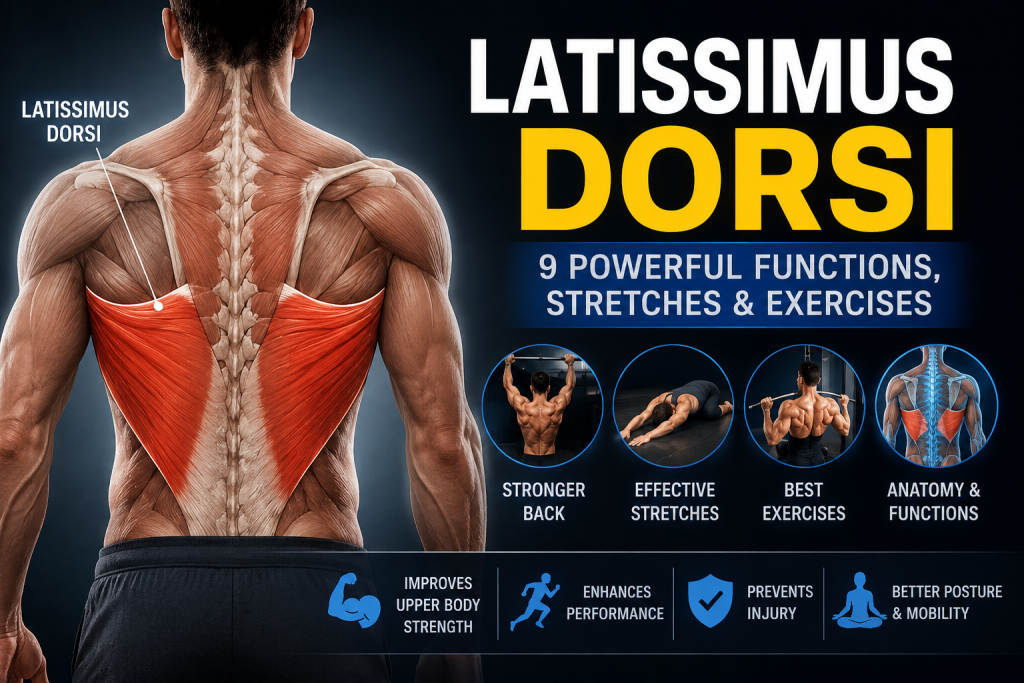
Latissimus Dorsi: 9 Powerful Functions, Stretches & Exercises
The latissimus dorsi is one of the largest muscles in the upper body. Often called the “lats,” this broad muscle covers a significant portion of the middle and lower back and plays an important role in moving the arms, supporting posture, and controlling several upper-body movements.
Whether you work at a desk, play sports, lift weights, or simply want better upper-body mobility, understanding the latissimus dorsi can help you recognize muscle tightness, reduce injury risk, and choose appropriate exercises.
Tight or strained back muscles can sometimes cause discomfort around the upper or middle back and may affect shoulder movement. Fortunately, regular mobility work, proper exercise technique, and gradual strengthening can help maintain healthy back and shoulder function.
This guide explains the anatomy, functions, common problems, stretches, exercises, and care strategies associated with this important back muscle.
What Is the Latissimus Dorsi?
The latissimus dorsi is a large, flat, triangular muscle located on both sides of the back. It extends from parts of the lower spine and pelvis toward the upper arm.
Because of its size and position, the muscle contributes to several movements involving the shoulder and arm. It is particularly active during pulling movements such as pull-ups, rows, and swimming.
The muscle is sometimes described as a major connection between the trunk and upper limb. When it contracts, it can help bring the arm backward and toward the body.
Strong lats can contribute to upper-body strength, while adequate flexibility allows the shoulders and arms to move through a comfortable range of motion.
Where Is the Latissimus Dorsi Located?
The latissimus dorsi covers a large area of the back. You can find it below the shoulder blade and along the sides of the middle and lower back.
It originates from several areas, including portions of the lower thoracic and lumbar spine, the thoracolumbar fascia, and the pelvis. It then travels upward and attaches to the upper arm bone near the shoulder.
Its broad structure explains why discomfort involving this muscle may sometimes feel like it is located along the side of the back rather than directly in the center.
The muscle also works closely with other muscles around the shoulder, spine, ribs, and trunk. For this reason, evaluating movement as a whole is often more useful than focusing on one muscle alone.
9 Powerful Functions of the Latissimus Dorsi
The latissimus dorsi has several important functions. Its main actions involve the shoulder and upper limb.
1. Shoulder Extension
One of the primary functions is helping move the upper arm backward. This movement is known as shoulder extension.
For example, when your arm moves from in front of your body toward your side or behind you, the lats can contribute to the movement.
2. Shoulder Adduction
The muscle also helps bring the arm toward the side of the body. This is called shoulder adduction.
Pulling your arm downward during a pull-up is one example where this function is important.
3. Internal Rotation
The latissimus dorsi contributes to internal rotation of the upper arm. This means it can help rotate the arm inward toward the body.
This action works together with several other shoulder muscles to control arm positioning.
4. Pulling Movements
The lats are heavily involved in pulling exercises. Pull-ups, chin-ups, lat pulldowns, and rowing variations can all recruit this muscle.
Developing strength in the lats can therefore improve performance during many upper-body activities.
5. Swimming Movements
Swimming requires repeated movements of the arms and shoulders. The latissimus dorsi contributes to several swimming strokes, particularly during powerful pulling phases.
Swimmers therefore rely on coordinated strength and mobility throughout the shoulders and back.
6. Climbing and Hanging
Activities such as climbing and hanging require strong shoulder and upper-back muscles. The lats can help control the arm while the body is being pulled upward or stabilized.
7. Upper-Body Stability
The lats can contribute to overall shoulder and trunk stability. They work with surrounding muscles to help control movement during lifting, pulling, and other activities.
8. Support During Athletic Movements
Many sports involve powerful arm movements. The lats can contribute to force production and coordination during activities such as throwing, paddling, climbing, and certain strength-training movements.
9. Assistance With Breathing Mechanics
Because of its broad attachment across the trunk, the latissimus dorsi can interact with the rib cage and surrounding tissues. It may contribute indirectly to trunk and breathing mechanics, particularly during forceful or strenuous activity.
What Causes Latissimus Dorsi Tightness?
Several factors may contribute to tightness in the latissimus dorsi.
One common cause is repetitive upper-body activity. People who frequently perform pulling exercises, swimming, climbing, or overhead movements may place substantial demands on their back and shoulders.
Poor movement mechanics can also contribute to muscle tension. For example, repeatedly performing exercises with excessive weight or poor shoulder control may place unnecessary stress on the surrounding tissues.
Long periods of inactivity can also affect mobility. Sitting for many hours does not necessarily “shorten” one specific muscle, but limited movement can contribute to stiffness throughout the shoulders and upper back.
Other possible contributors include:
- Sudden increases in exercise intensity
- Inadequate warm-up
- Repetitive overhead activity
- Poor exercise technique
- Muscle fatigue
- Previous muscle injury
- Limited shoulder mobility
Symptoms of a Tight or Strained Latissimus Dorsi
Symptoms can vary depending on the underlying problem.
A person with muscle tightness may notice stiffness along the side of the back or difficulty moving the shoulder comfortably. Some people may feel tension when reaching overhead or stretching the arm.
A muscle strain may produce more noticeable pain, especially during movements that contract or stretch the muscle.
Possible symptoms include:
- Aching or tightness in the side of the back
- Discomfort around the shoulder or upper back
- Pain during pulling movements
- Pain when reaching overhead
- Reduced shoulder mobility
- Muscle tenderness
- Weakness during certain movements
- Discomfort after intense exercise
However, not every type of back or shoulder pain comes from the lats. Nerve problems, shoulder conditions, spinal issues, and other muscular injuries can produce similar symptoms.
5 Effective Latissimus Dorsi Stretches
Stretching can be useful when muscle tightness is contributing to limited mobility. Stretches should feel gentle rather than painful.
1. Child’s Pose With Side Reach
Start on your hands and knees. Slowly move your hips backward toward your heels and extend your arms forward.
To emphasize one side, gently walk both hands toward the opposite side. You should feel a stretch along the side of your back.
Hold for about 20–30 seconds while breathing comfortably.
2. Overhead Side Stretch
Stand upright and raise one arm overhead. Slowly lean your torso toward the opposite side.
Avoid twisting aggressively. Keep the movement controlled and stop if you experience sharp pain.
Hold the stretch for 20–30 seconds before switching sides.
3. Wall Lat Stretch
Place both hands on a wall or sturdy surface. Step backward and hinge your hips slightly while keeping your arms extended.
Allow your chest to move downward while your hips move backward. This can create a gentle stretch through the shoulders and sides of the back.
4. Bench Lat Stretch
Kneel in front of a stable bench or similar surface. Place your elbows or hands on the bench and slowly move your hips backward.
Keep the movement comfortable and avoid forcing your shoulders into a painful position.
5. Cat-Cow Mobility
Begin on your hands and knees. Slowly alternate between gently rounding your back and extending it.
This is more of a mobility exercise than an isolated stretch, but it can help promote comfortable movement through the spine and upper back.
4 Best Latissimus Dorsi Exercises
Strengthening the lats can improve pulling strength and upper-body function. Start with manageable resistance and prioritize technique.
1. Lat Pulldown
Sit at a lat pulldown machine and grip the bar comfortably.
Pull the bar toward the upper chest while keeping the movement controlled. Avoid pulling excessively behind your neck.
Slowly return the bar to the starting position.
Focus on moving through the shoulders rather than simply using your hands to pull the weight.
2. Assisted Pull-Up
If a full pull-up is difficult, an assisted pull-up machine or resistance band can provide support.
Start with your arms extended and pull your body upward while keeping your movements controlled.
Gradually increase difficulty as your strength improves.
3. Dumbbell Row
Place one hand and knee on a stable bench. Hold a dumbbell with the opposite hand.
Pull the dumbbell toward your hip while keeping your back stable. Slowly lower the weight.
Avoid rotating your torso to lift heavier weights.
4. Straight-Arm Pulldown
Attach a suitable handle to a cable machine. Stand upright and hold the handle with your arms extended.
Keeping the elbows mostly straight, pull the handle downward toward your thighs.
Return slowly to the starting position.
Use light-to-moderate resistance and focus on controlled movement.
How to Strengthen the Latissimus Dorsi Safely
Progressive training is usually more useful than immediately lifting heavy weights.
Start with a resistance level that allows you to perform the exercise with good technique. As the movement becomes easier, gradually increase repetitions, resistance, or training volume.
Warm up before demanding workouts. A few minutes of light activity followed by controlled shoulder and upper-back mobility can prepare your body for exercise.
Recovery also matters. Muscles need adequate rest between challenging training sessions.
If you experience persistent pain rather than normal exercise fatigue, reduce the intensity and consider professional evaluation.
Latissimus Dorsi vs. Other Back Muscles
The latissimus dorsi is only one part of the back.
The trapezius helps control the shoulder blades and neck region. The rhomboids contribute to shoulder-blade movement, while the erector spinae help support and move the spine.
The teres major is another muscle located near the shoulder that contributes to arm movement and works closely with the lats.
Because these muscles often work together, a balanced back-training program should not focus exclusively on one muscle.
Combining pulling exercises, shoulder mobility, trunk control, and appropriate strengthening can create a more complete approach to upper-body fitness.
How Long Does Latissimus Dorsi Tightness Take to Improve?
The recovery time depends on why the muscle feels tight.
Mild exercise-related stiffness may improve within a few days with appropriate rest and gentle movement. A more significant strain may require considerably longer.
Avoid repeatedly testing a painful movement simply to see whether it has improved. Returning to intense exercise too quickly may delay recovery.
Instead, gradually return to normal activity as comfortable movement and strength improve.
When Should You See a Physiotherapist?
A physiotherapist can assess movement, muscle strength, flexibility, and the mechanics of the shoulder and spine.
Professional evaluation may be useful if:
- Pain continues despite reducing activity
- You have significant weakness
- Shoulder movement is becoming limited
- Pain repeatedly returns during exercise
- You experienced a sudden injury
- You cannot perform normal daily activities comfortably
- Symptoms are getting worse
A physiotherapist can develop an individualized rehabilitation program based on the suspected cause of the problem.
Tips for Preventing Latissimus Dorsi Injuries
You can reduce the risk of muscle problems by building strength gradually and maintaining good movement habits.
Warm up before intense exercise, especially before pulling or overhead movements. Use appropriate resistance and avoid sacrificing technique to complete additional repetitions.
Include both strengthening and mobility exercises in your routine. Give your body adequate recovery time after demanding workouts.
If you are new to strength training, learning correct exercise technique can make a significant difference.
Good general habits include:
- Increase training volume gradually
- Use controlled exercise movements
- Warm up before intense workouts
- Maintain shoulder mobility
- Strengthen the entire upper body
- Take recovery days
- Avoid training through sharp pain
- Seek professional advice after significant injuries
Frequently Asked Questions
What is the latissimus dorsi?
The latissimus dorsi is a large, broad muscle located on both sides of the back. It helps move the upper arm and contributes to pulling, climbing, swimming, and other upper-body activities.
What does the latissimus dorsi do?
Its major actions include shoulder extension, adduction, and internal rotation. It also contributes to upper-body stability and powerful pulling movements.
How can I stretch my lats?
Child’s pose with a side reach, overhead side stretches, wall stretches, and bench stretches can provide gentle mobility work for the lats.
What exercises work the lats best?
Lat pulldowns, pull-ups, assisted pull-ups, dumbbell rows, and straight-arm pulldowns are common exercises that recruit the lats.
Can tight lats cause shoulder problems?
Limited mobility in the muscles and tissues around the shoulder can affect movement mechanics. However, shoulder pain has many possible causes, so persistent symptoms should be properly assessed.
Final Thoughts
The latissimus dorsi is a powerful and versatile back muscle that plays an important role in shoulder movement and upper-body strength. Keeping the muscle strong while maintaining comfortable mobility can support better performance in exercise and everyday activities.
A balanced routine should include appropriate strengthening, mobility work, recovery, and good exercise technique. If pain, weakness, or restricted movement persists, professional assessment is a safer option than continuing to train through symptoms.
Understanding how the lats work can help you make smarter decisions about exercise and back health. Whether your goal is stronger pulling power, improved mobility, or better athletic performance, taking care of this large back muscle can be an important part of a well-rounded fitness and physiotherapy routine.