Physiotherapy for Shoulder Subluxation: 9 Powerful Exercises for Faster Recovery
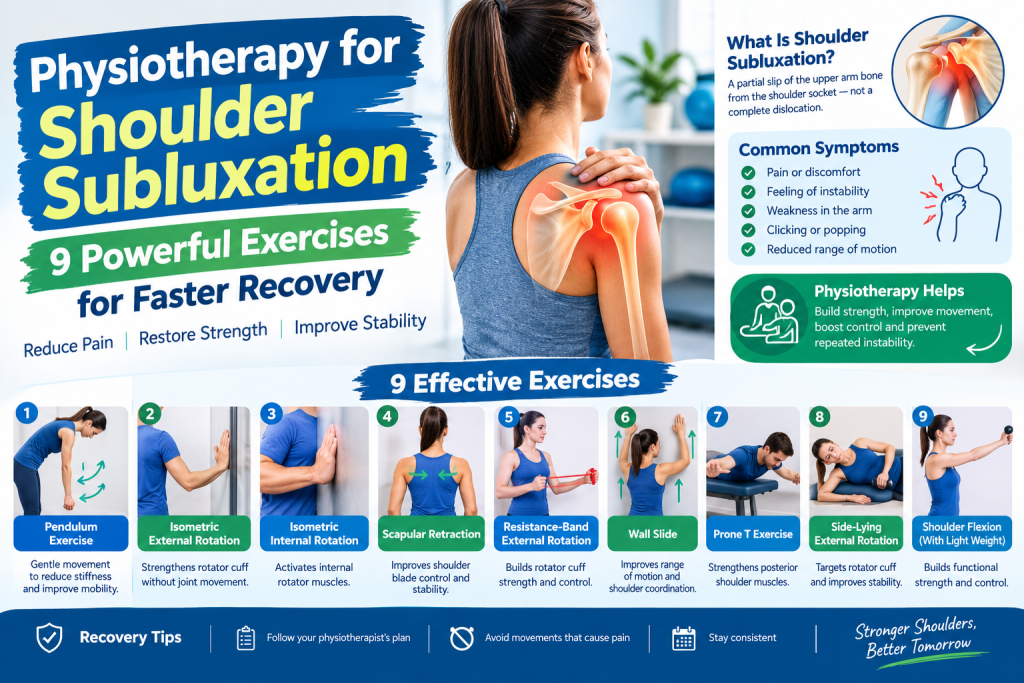
A shoulder subluxation occurs when the upper arm bone partially slips out of the shoulder socket but does not completely dislocate. It can cause pain, weakness, instability, clicking, or a feeling that the shoulder may “give way.” Because the shoulder is designed for a wide range of movement, it depends heavily on muscles, tendons, ligaments, and coordinated movement to remain stable.
Physiotherapy for shoulder subluxation can play an important role in recovery by helping restore strength, improve movement, develop better shoulder control, and reduce the risk of repeated instability. A physiotherapist can assess the shoulder and create an exercise program based on the cause and severity of the subluxation.
This guide explains nine commonly used exercise approaches, recovery tips, warning signs, and what to expect from rehabilitation.
What Is a Shoulder Subluxation?
A shoulder subluxation is a partial displacement of the humeral head from the shoulder socket, known as the glenoid. Unlike a complete shoulder dislocation, the joint may move back into its normal position on its own.
Subluxation can happen because of a sudden injury, sports activity, repetitive overhead movements, muscle weakness, ligament laxity, or previous shoulder instability.
Common symptoms may include:
- Shoulder pain or discomfort
- A feeling of looseness or instability
- Weakness in the arm
- Clicking or popping
- Reduced confidence when moving the arm
- Difficulty lifting the arm
- A sensation that the shoulder is slipping
- Reduced range of motion after an injury
The symptoms can vary considerably from person to person. For this reason, rehabilitation should ideally be individualized rather than based on a one-size-fits-all exercise routine.
Why Physiotherapy Is Important for Shoulder Subluxation
The main goal of physiotherapy for shoulder subluxation is not simply to reduce pain. Rehabilitation also aims to improve the shoulder’s ability to control movement and remain stable during everyday activities and exercise.
The shoulder relies on several structures for stability, including the rotator cuff, shoulder blade muscles, joint capsule, ligaments, and surrounding muscles. Improving the strength and coordination of these structures can help the shoulder function more effectively.
A physiotherapist may work on:
- Pain management
- Shoulder mobility
- Rotator cuff strength
- Scapular control
- Proprioception and joint awareness
- Functional movement
- Gradual return to sports or work
- Prevention of recurrent instability
Your rehabilitation plan may change as your shoulder becomes stronger and more stable.
9 Powerful Exercises for Shoulder Subluxation
The following exercises are examples of movements that may be included in rehabilitation. They are not suitable for every person or every stage of recovery. If an exercise causes significant pain, instability, numbness, or a slipping sensation, stop and seek professional advice.
1. Pendulum Exercise
Pendulum exercises are gentle movements that may be useful when the shoulder is stiff or uncomfortable.
To perform the exercise, lean forward while supporting yourself with your unaffected arm. Allow the affected arm to hang loosely toward the floor. Gently move the arm forward and backward, side to side, or in small circles.
The movement should be relaxed rather than forceful.
Pendulums may help maintain gentle shoulder movement without requiring strong muscle contractions.
Perform the exercise slowly and avoid large circles if they make your shoulder feel unstable.
2. Isometric External Rotation
Isometric exercises strengthen muscles without requiring significant joint movement. External rotation is particularly important because the rotator cuff contributes to shoulder stability.
Stand beside a wall or doorway with your affected arm close to your body. Bend your elbow to approximately 90 degrees. Place the back of your hand against the surface and gently push outward without actually moving your arm.
Hold the contraction for several seconds and relax.
The pressure should be controlled and comfortable. Avoid pushing aggressively, particularly during the early stages of rehabilitation.
3. Isometric Internal Rotation
Internal rotation can also be trained using an isometric contraction.
Stand with your elbow bent and close to your side. Place the palm or front of your hand against a stable surface. Gently push inward without allowing your arm to move.
Hold for a few seconds and then relax.
This exercise can help activate the muscles responsible for internal rotation and contribute to overall shoulder strength.
Your physiotherapist can determine the appropriate resistance and number of repetitions based on your condition.
4. Scapular Retraction
The shoulder blade plays an important role in shoulder mechanics. Poor scapular control can affect how the shoulder moves during lifting and reaching.
Sit or stand with your back straight. Gently draw your shoulder blades backward and slightly downward, as though you are trying to bring them toward each other.
Do not shrug your shoulders toward your ears.
Hold the position briefly and then relax.
Scapular retraction is a simple movement, but controlled repetition can help develop awareness of shoulder-blade positioning.
5. Resistance-Band External Rotation
Once basic strength and control have improved, a resistance band may be introduced.
Attach a resistance band to a secure point. Stand with your affected arm closest to the anchor point. Keep your elbow bent and tucked close to your body.
Slowly rotate your forearm away from your abdomen while keeping your elbow near your side. Return to the starting position in a controlled manner.
This exercise targets the external rotators of the shoulder.
Start with light resistance. Increasing resistance too quickly can place unnecessary stress on the recovering shoulder.
6. Resistance-Band Internal Rotation
Internal rotation with a resistance band can complement external rotation exercises.
Attach the band securely and stand with the affected arm closest to the anchor. Keep your elbow bent and close to your body.
Pull the band inward across your body using a slow, controlled movement. Return gradually to the starting position.
Avoid twisting your entire body to complete the movement.
The goal is controlled shoulder movement rather than simply moving the greatest amount of resistance possible.
7. Wall Slides
Wall slides can help develop shoulder movement and coordination.
Stand facing a wall with your hands or forearms lightly touching it. Slowly slide your arms upward as far as comfortable.
Keep the movement controlled and avoid forcing the shoulder into a painful or unstable position.
As your mobility and control improve, your physiotherapist may gradually increase the range of movement.
Wall exercises can also help you learn how to coordinate the shoulder blade with arm movement.
8. Serratus Anterior Strengthening
The serratus anterior is an important muscle for controlling the shoulder blade against the rib cage.
A simple version can be performed against a wall. Place your hands on the wall and gently push your body away while maintaining good posture. Focus on controlled movement of the shoulder blades rather than bending and straightening your elbows excessively.
More advanced variations can be introduced as strength improves.
Because shoulder instability varies from person to person, a physiotherapist can select the safest version for your stage of recovery.
9. Controlled Functional Reaching
Once basic strength and stability have improved, rehabilitation may progress toward functional movements.
This can include controlled reaching at different heights, light resistance exercises, or movements that resemble activities you perform at work or during sports.
Functional training is important because your shoulder needs to remain stable while you perform real-world tasks—not just while completing isolated exercises.
Progress should be gradual, particularly if your shoulder has previously slipped out of position.
How Physiotherapy for Shoulder Subluxation Supports Recovery
A complete rehabilitation program usually involves more than exercises.
Your physiotherapist may begin by assessing your pain, range of motion, muscle strength, joint stability, posture, movement patterns, and functional limitations.
Depending on the findings, treatment may include therapeutic exercises, movement retraining, education, activity modification, and a progressive strengthening program.
Early rehabilitation may focus on comfortable movement and muscle activation. Later stages may emphasize strength, coordination, dynamic stability, and functional activities.
The progression should depend on your symptoms and clinical assessment rather than a fixed timetable.
How Long Does Shoulder Subluxation Recovery Take?
Recovery time varies depending on several factors.
These can include:
- Severity of the injury
- Cause of the subluxation
- Previous shoulder injuries
- Age and activity level
- Muscle strength
- Joint stability
- Treatment consistency
- Whether other structures were injured
Some people improve relatively quickly, while others require a longer rehabilitation period.
Returning to demanding sports or heavy lifting before adequate strength and control have returned may increase the risk of another episode.
Instead of focusing only on the number of weeks since the injury, rehabilitation should focus on measurable improvements in strength, movement, stability, and function.
What Should You Avoid During Recovery?
Certain movements may be inappropriate during the early stages of rehabilitation, especially if they reproduce instability.
Depending on your injury, you may need to temporarily avoid:
- Heavy overhead lifting
- Sudden pulling movements
- Contact sports
- Aggressive stretching
- Heavy bench pressing
- Repetitive throwing
- Exercises that cause the shoulder to feel unstable
- Returning to sports too quickly
Avoiding an activity temporarily does not mean you can never perform it again. The goal is usually to modify activity while rebuilding the capacity of the shoulder.
A physiotherapist can help determine when and how to reintroduce specific movements.
Can Physiotherapy Prevent Recurrent Shoulder Subluxation?
Physiotherapy can help address modifiable factors associated with shoulder instability, particularly muscle weakness, poor movement control, and reduced coordination.
Strengthening the rotator cuff and scapular muscles can improve dynamic support around the shoulder. Proprioceptive and functional exercises can also help the body respond more effectively to changes in shoulder position.
However, physiotherapy cannot guarantee that a subluxation will never happen again.
People with recurrent instability or structural injuries may require further medical assessment. In some cases, a physician or orthopedic specialist may recommend additional treatment.
When Should You See a Physiotherapist?
Consider professional assessment if you experience repeated shoulder slipping, ongoing pain, weakness, reduced movement, or difficulty returning to normal activities after an injury.
You should seek prompt medical evaluation after a significant shoulder injury, especially if the shoulder appears visibly deformed or you cannot move the arm normally.
Urgent assessment is particularly important if you develop severe pain, significant swelling, numbness, tingling, or changes in the color or temperature of the arm or hand.
A professional examination can help determine whether the problem is a subluxation, complete dislocation, fracture, rotator cuff injury, labral injury, or another condition.
Tips for a Successful Shoulder Rehabilitation Program
Consistency is one of the most important parts of rehabilitation. Completing exercises occasionally is unlikely to provide the same benefit as following an appropriate program consistently.
Keep these principles in mind:
Start Gradually
Do not rush into heavy resistance or advanced exercises. Your shoulder needs time to regain strength and control.
Focus on Technique
Quality is usually more important than the number of repetitions. Perform each exercise slowly and maintain good alignment.
Respect Pain and Instability
Mild muscle fatigue can occur during strengthening, but sharp pain or a feeling that the shoulder is slipping should not be ignored.
Progress Slowly
Resistance, repetitions, range of motion, and functional demands can be increased gradually as your shoulder improves.
Follow Professional Advice
If you have a diagnosed shoulder injury, follow the rehabilitation plan provided by your healthcare professional.
Frequently Asked Questions
Can physiotherapy fix a shoulder subluxation?
Physiotherapy can help improve strength, mobility, coordination, and shoulder stability. However, whether physiotherapy alone is sufficient depends on the cause and severity of the subluxation and whether there is underlying structural damage.
What is the best exercise for shoulder subluxation?
There is no single best exercise for everyone. Rotator cuff strengthening, scapular control, and progressive stability exercises are commonly incorporated into rehabilitation, but the appropriate exercises depend on the individual’s condition.
Can I exercise with a shoulder subluxation?
You may be able to exercise, but the type and intensity of exercise should be appropriate for your stage of recovery. Avoid movements that cause significant pain or instability and obtain professional guidance after an injury.
How can I strengthen my shoulder after a subluxation?
A progressive program may include isometric exercises, resistance-band exercises, rotator cuff strengthening, scapular exercises, and functional movements. The program should progress gradually according to your symptoms and strength.
Can shoulder subluxation happen again?
Yes. Recurrent instability can occur, particularly in people with previous shoulder instability or certain structural injuries. Appropriate rehabilitation and medical assessment can help determine the best strategy for reducing future episodes.
Final Thoughts
Physiotherapy for shoulder subluxation can be an important part of restoring shoulder strength, movement, coordination, and stability. A well-designed rehabilitation program may progress from gentle movement and muscle activation to resistance training and functional activities.
The nine exercises discussed in this guide—including pendulums, isometric rotations, scapular exercises, resistance-band strengthening, wall slides, and functional reaching—may be useful components of rehabilitation when appropriately selected.
However, shoulder instability is not identical for everyone. If your shoulder repeatedly slips, you have significant pain or weakness, or the injury occurred during a major accident or sports event, professional assessment is important.
With an appropriate diagnosis, gradual strengthening, good exercise technique, and consistent rehabilitation, many people can work toward better shoulder function and a confident return to daily activities.